

Quantity#


brainunit generates standard names for units, combining the unit name (e.g. “siemens”) with a prefixes (e.g. “m”), and also generates squared and cubed versions by appending a number. For example, the units “msiemens”, “siemens2”, “usiemens3” are all predefined. You can import these units from the package brainunit – accordingly, an from brainunit import * will result in everything being imported.
We recommend importing only the units you need, to have a cleaner namespace. For example, import brainunit as u and then using u.msiemens instead of msiemens.
import brainunit as u
In the underlying design, Quantity consists of two attributes (mantissa and unit), and the specific value it represents is calculated by the formula below:
where unit.base is the base for this unit (as the base of the exponent) and unit.scale is the scale for this unit (as the integer exponent of base)
A quantity is equivalent to the scientific notation of
For example, 5 * ms is equivalent to 5 * 10^-3 * s = 5 * 0.001 * s = 0.005 * s.
You can generate a physical quantity by multiplying a scalar or ndarray with its physical unit:
tau = 20 * u.ms
tau
Quantity(20, "ms")
rates = [10, 20, 30] * u.Hz
rates
Quantity([10 20 30], "Hz")
rates = [[10, 20, 30], [20, 30, 40]] * u.Hz
rates
Quantity([[10 20 30]
          [20 30 40]], "Hz")
brainunit will check the consistency of operations on units and raise an error for dimensionality mismatches:
try:
    tau += 1  # ms? second?
except Exception as e:
    print(e)
Cannot calculate
20 ms += 1, because units do not match: ms != 1
try:
    3 * u.kgram + 3 * u.amp
except Exception as e:
    print(e)
Cannot calculate
3 kg + 3 A, because units do not match: kg != A
Creating Quantity Instances#
Creating a Quantity object can be accomplished in several ways, categorized based on the type of input used. Here, we present the methods grouped by their input types and characteristics for better clarity.
import jax.numpy as jnp
Scalar and Array Multiplication#
Multiplying a Scalar with a Unit
5 * u.ms
Quantity(5, "ms")
Multiplying a Jax nunmpy value type with a Unit:
jnp.float64(5) * u.ms
/opt/hostedtoolcache/Python/3.14.7/x64/lib/python3.14/site-packages/jax/_src/numpy/scalar_types.py:55: UserWarning: Explicitly requested dtype float64 requested in asarray is not available, and will be truncated to dtype float32. To enable more dtypes, set the jax_enable_x64 configuration option or the JAX_ENABLE_X64 shell environment variable. See https://github.com/jax-ml/jax#current-gotchas for more.
  return asarray(x, dtype=self.dtype)
Quantity(5., "ms")
Multiplying a Jax numpy array with a Unit:
jnp.array([1, 2, 3]) * u.ms
Quantity([1 2 3], "ms")
Multiplying a List with a Unit:
[1, 2, 3] * u.ms
Quantity([1 2 3], "ms")
Direct Quantity Creation#
Creating a Quantity Directly with a Value
u.Quantity(5)
Quantity(5)
Creating a Quantity Directly with a Value and Unit
u.Quantity(5, unit=u.ms)
Quantity(5, "ms")
Creating a Quantity with a Jax numpy Array of Values and a Unit
u.Quantity(jnp.array([1, 2, 3]), unit=u.ms)
Quantity([1 2 3], "ms")
Creating a Quantity with a List of Values and a Unit
u.Quantity([1, 2, 3], unit=u.ms)
Quantity([1 2 3], "ms")
Creating a Quantity with a List of Quantities
u.Quantity([500 * u.ms, 1 * u.second])
Quantity([ 500. 1000.], "ms")
Using the with_units Method
u.Quantity.with_unit(jnp.array([0.5, 1]), unit=u.second)
Quantity([0.5 1. ], "s")
Unitless Quantity#
Quantities can be unitless, which means they have no units. If there is no unit provided, the quantity is assumed to be unitless. The following are examples of creating unitless quantities:
u.Quantity([1, 2, 3])
Quantity([1 2 3])
u.Quantity(jnp.array([1, 2, 3]))
Quantity([1 2 3])
u.Quantity([])
Quantity([])
Illegal Quantity Creation#
The following are examples of illegal quantity creation:
try:
    u.Quantity([500 * u.ms, 1])
except Exception as e:
    print(e)
All elements must have the same units, but got [Unit("ms"), Unit("1")]
try:
    u.Quantity(["some", "nonsense"])
except Exception as e:
    print(e)
Value 'some' with dtype <U4 is not a valid JAX array type. Only arrays of numeric types are supported by JAX.
try:
    u.Quantity([500 * u.ms, 1 * u.volt])
except Exception as e:
    print(e)
All elements must have the same units, but got [Unit("ms"), Unit("V")]
Creating Functions#
You can create functions that return quantities. The following are examples of creating functions that return quantities:
brainunit.math.array & brainunit.math.asarray#
Convert the input to a quantity or array.
If unit is provided, the input will be checked whether it has the same unit as the provided unit. (If they have same unit but different scale, the input will be converted to the provided unit.) If unit is not provided, the input will be converted to an array.
u.math.asarray([1, 2, 3]) # return a jax.Array
Array([1, 2, 3], dtype=int32)
# check if the input has the same unit as the provided unit
u.math.asarray([1, 2, 3] * u.second, unit=u.second)    # return a Quantity
Quantity([1 2 3], "s")
# Same unit, but different scale
u.math.asarray([1, 2, 3] * u.msecond, unit=u.second)    # return a Quantity
Quantity([0.001 0.002 0.003], "s")
# fails because the input has a different unit
try:
    u.math.asarray([1 * u.second, 2 * u.second], unit=u.ampere)
except Exception as e:
    print(e)
Cannot convert to a unit with different dimensions. (units are s and A).
More Functions#
Other functions that can be used to create quantities are:
brainunit.math.arangebrainunit.math.array_spiltbrainunit.math.linespacebrainunit.math.logspacebrainunit.math.meshgridbrainunit.math.vandermodeCan use with Quantity
brainunit.math.fullbrainunit.math.emptybrainunit.math.onesbrainunit.math.zerosbrainunit.math.full_likebrainunit.math.empty_likebrainunit.math.ones_likebrainunit.math.zeros_likebrainunit.math.fill_diagonal
Can use with unit keyword
brainunit.math.eyebrainunit.math.identitybrainunit.math.tribrainunit.math.diagbrainunit.math.trilbrainunit.math.triu
See the Array Creation Documentation for more information.
Converting to Different Units#
You can convert a quantity to a different unit using the to_decimal method. The following are examples of converting quantities to different units:
q = (1, 2, 3) * u.second
q
Quantity([1 2 3], "s")
q.to_decimal(u.msecond)
Array([1000., 2000., 3000.], dtype=float32, weak_type=True)
brainunit will check the consistency of operations on units and raise an error for dimensionality mismatches:
try:
    q.to_decimal(u.ampere)
except Exception as e:
    print(e)
Cannot convert to the decimal number using a unit with different dimensions. (units are s and A).
Attributes of a Quantity#
The important attributes of a Quantity object are:
mantissa: the mantissa of the quantityunit: the unit of the quantitydim: the dimension of the unit of the quantityndim: the number of dimensions of quantity’s valueshape: the shape of the quantity’s valuesize: the size of the quantity’s valuedtype: the dtype of the quantity’s value
An example#
rates = [[10., 20., 30.], [20., 30., 40.]] * u.Hz
rates
Quantity([[10. 20. 30.]
          [20. 30. 40.]], "Hz")
rates.mantissa
Array([[10., 20., 30.],
       [20., 30., 40.]], dtype=float32)
rates.dim
second ** -1
rates.ndim, rates.shape, rates.size, rates.dtype
(2, (2, 3), 6, dtype('float32'))
Arithmetic Functions#
Like Numpy and Jax numpy, arithmetic operators on arrays apply elementwise.
a = [20, 30, 40, 50] * u.mV
b = jnp.arange(4) * u.mV
b
Quantity([0 1 2 3], "mV")
Addition and Subtraction#
Addition and subtraction of quantities need to have the same units and keep the units in the result.
c = a - b
c
Quantity([20 29 38 47], "mV")
c + b
Quantity([20 30 40 50], "mV")
Multiplication and Division#
Multiplication and division of quantities multiply and divide the values and add and subtract the dimensions of the units.
A = jnp.array([[1, 2], [3, 4]]) * u.mV
B = jnp.array([[5, 6], [7, 8]]) * u.mV

A, B
(Quantity([[1 2]
           [3 4]], "mV"),
 Quantity([[5 6]
           [7 8]], "mV"))
A * B # element-wise multiplication
Quantity([[ 5 12]
          [21 32]], "mV^2")
A @ B # matrix multiplication
Quantity([[19 22]
          [43 50]], "mV^2")
A.dot(B) # matrix multiplication
Quantity([[19 22]
          [43 50]], "mV^2")
A / 2 # divide by a scalar
Quantity([[0.5 1. ]
          [1.5 2. ]], "mV")
if the unit of result is unitless, the unit is removed and returned as jax.Array
A / (2 * u.mV) # divide by a quantity, return jax array
Array([[0.5, 1. ],
       [1.5, 2. ]], dtype=float32)
A / (2 * u.mA) # divide by a quantity, return quantity
Quantity([[0.5 1. ]
          [1.5 2. ]], "ohm")
Power#
The power operator raises the value of the quantity to the power of the scalar, and multiplies the unit by the scalar.
A
Quantity([[1 2]
          [3 4]], "mV")
A ** 2 # element-wise power
Quantity([[ 1  4]
          [ 9 16]], "mV^2")
Built-in Functions#
brainunit provides a number of built-in functions in Quantity class to perform operations on quantities. These functions are:
unary operations
positive(+)
negative(-)
absolute(abs)
invert(~)
logical operations
all
any
shape operations
reshape
resize
squeeze
unsqueeze
spilt
swapaxes
transpose
ravel
take
repeat
diagonal
trace
mathematical functions
nonzero
argmax
argmin
argsort
var
round
std
sum
cumsum
cumprod
max
mean
min
ptp
clip
conj
dot
fill
item
prod
clamp
sort
For more details on these functions, refer to the documentation.
Indexing, Slicing and Iterating#
One-dimensional Quantity can be indexed, sliced and iterated over, much like lists and other Python sequences.
a = jnp.arange(10) ** 3 * u.mV
a
Quantity([ 0 1 8 27 64 125 216 343 512 729], "mV")
a[2]
Quantity(8, "mV")
a[2:5]
Quantity([ 8 27 64], "mV")
Only same dimension Quantity can be set to a slice of a Quantity.
# equivalent to a[0:6:2] = 1000;
# from start to position 6, exclusive, set every 2nd element to 1000
a[:6:2] = 1000 * u.mV
a
Quantity([1000 1 1000 27 1000 125 216 343 512 729], "mV")
a[::-1] # reversed a
Quantity([ 729 512 343 216 125 1000 27 1000 1 1000], "mV")
for i in a:
    print(i**(1 / 3.))
10.000001 mV^0.3333333333333333
1. mV^0.3333333333333333
10.000001 mV^0.3333333333333333
3. mV^0.3333333333333333
10.000001 mV^0.3333333333333333
5.0000005 mV^0.3333333333333333
6.0000005 mV^0.3333333333333333
7.0000005 mV^0.3333333333333333
8.000001 mV^0.3333333333333333
9.000001 mV^0.3333333333333333
Multidimensional Quantity can have one index per axis. These indices are given in a tuple separated by commas:
def f(x, y):
    return 10 * x + y
b = jnp.fromfunction(f, (5, 4), dtype=jnp.int32) * u.mV
b
Quantity([[ 0  1  2  3]
          [10 11 12 13]
          [20 21 22 23]
          [30 31 32 33]
          [40 41 42 43]], "mV")
b[2, 3]
Quantity(23, "mV")
b[0:5, 1] # each row in the second column of b
Quantity([ 1 11 21 31 41], "mV")
b[:, 1] # equivalent to the previous example
Quantity([ 1 11 21 31 41], "mV")
b[1:3, :] # each column in the second and third row of b
Quantity([[10 11 12 13]
          [20 21 22 23]], "mV")
When fewer indices are provided than the number of axes, the missing indices are considered complete slices:
b[-1]
Quantity([40 41 42 43], "mV")
The expression within brackets in b[i] is treated as an i followed by as many instances of : as needed to represent the remaining axes. NumPy also allows you to write this using dots as b[i, …].
The dots (…) represent as many colons as needed to produce a complete indexing tuple. For example, if x is a Quantity with 5 axes, then
x[1, 2, …] is equivalent to x[1, 2, :, :, :],
x[…, 3] to x[:, :, :, :, 3] and
x[4, …, 5, :] to x[4, :, :, 5, :].
c = jnp.array([[[0, 1, 2], [10, 12, 13]], [[100, 101, 102], [110, 112, 113]]]) * u.mV # a 3D array (two stacked 2D arrays)
c.shape
(2, 2, 3)
c[1, ...] # same as c[1, :, :] or c[1]
Quantity([[100 101 102]
          [110 112 113]], "mV")
c[..., 2] # same as c[:, :, 2]
Quantity([[  2  13]
          [102 113]], "mV")
Iterating over multidimensional Quantity is done with respect to the first axis:
for row in b:
    print(row)
[0 1 2 3] mV
[10 11 12 13] mV
[20 21 22 23] mV
[30 31 32 33] mV
[40 41 42 43] mV
Operating on Subsets#
.at method can be used to operate on a subset of the Quantity. The following are examples of operating on subsets of a Quantity:
q = jnp.arange(5.0) * u.mV
q
Quantity([0. 1. 2. 3. 4.], "mV")
q.at[2].add(10 * u.mV)
Quantity([ 0. 1. 12. 3. 4.], "mV")
q.at[10].add(10 * u.mV) # out-of-bounds indices are ignored
Quantity([0. 1. 2. 3. 4.], "mV")
q.at[20].add(10 * u.mV, mode='clip') # out-of-bounds indices are clipped
Quantity([ 0. 1. 2. 3. 14.], "mV")
q.at[2].get()
Quantity(2., "mV")
q.at[20].get() # out-of-bounds indices clipped
Quantity(4., "mV")
q.at[20].get(mode='fill') # out-of-bounds indices filled with NaN
Quantity(nan, "mV")
brainunit will check the consistency of operations on units and raise an error for dimensionality mismatches:
try:
    q.at[2].add(10)
except Exception as e:
    print(e)
Cannot convert to a unit with different dimensions. (units are 1 and mV).
brainunit also allows customized fill values for the at method:
q.at[20].get(mode='fill', fill_value=-1 * u.mV) # custom fill value
Quantity(-1., "mV")
try:
    q.at[20].get(mode='fill', fill_value=-1)
except Exception as e:
    print(e)
Cannot convert to a unit with different dimensions. (units are 1 and mV).
Plotting Quantities#
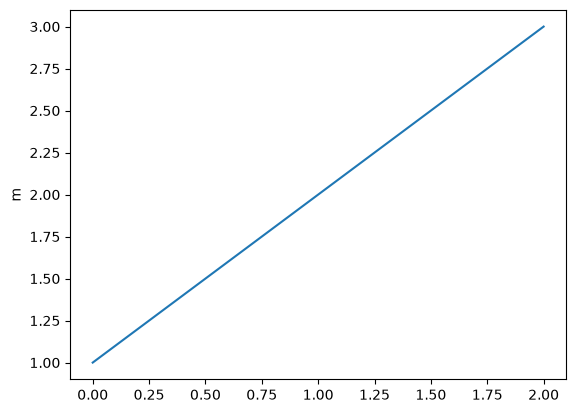
Quantity objects can be conveniently plotted using Matplotlib. This feature will be turned on automatically if Matplotlib is installed. The following are examples of plotting quantities:
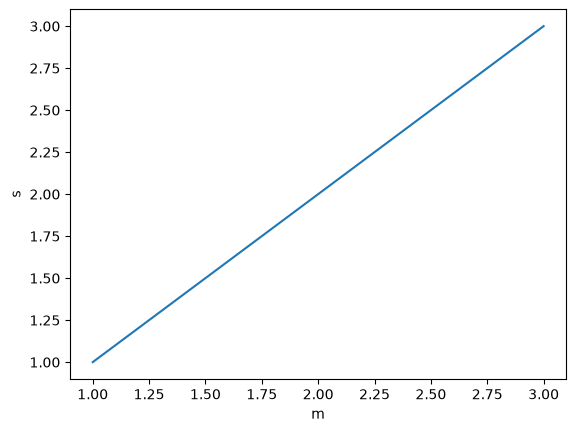
Then Quantity objects can be passed to matplotlib plotting functions. The axis labels are automatically labeled with the unit of the quantity:
from matplotlib import pyplot as plt

plt.figure()
plt.plot([1, 2, 3] * u.meter)
[<matplotlib.lines.Line2D at 0x7fa74c747a10>]
plt.plot([1, 2, 3] * u.meter, [1, 2, 3] * u.second)
[<matplotlib.lines.Line2D at 0x7fa74c7da3c0>]
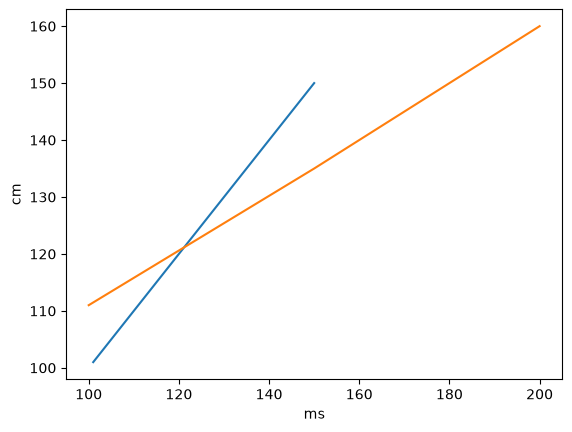
brainunit also supports plotting different scales of quantities with same unit on the same axis:
plt.plot([101, 125, 150] * u.ms, [101, 125, 150] * u.cmeter)
plt.plot([0.1, 0.15, 0.2] * u.second, [111, 135, 160] * u.cmeter)
[<matplotlib.lines.Line2D at 0x7fa74c6e4980>]
It is not allowed to plot quantities with different units on the same axis:
try:
    plt.plot([101, 125, 150] * u.ms, [101, 125, 150] * u.cmeter)
    plt.plot([0.1, 0.15, 0.2] * u.second, [111, 135, 160] * u.cmeter)
    plt.plot([0.1, 0.15, 0.2] * u.second, [131, 155, 180] * u.mA)
except Exception as e:
    print(e)
Failed to convert value(s) to axis units: Quantity([131 155 180], "mA")