
BrainTrace documentation#
BrainTrace implements scalable online learning for recurrent neural networks (RNNs) and spiking neural networks (SNNs) using eligibility trace propagation (ETP). Choose an entry point below to begin.
Installation#
Choose the platform that will run JAX. BrainTrace requires Python 3.11 or newer.
pip install -U "braintrace[cpu]"
CUDA 12:
pip install -U "braintrace[cuda12]"
CUDA 13:
pip install -U "braintrace[cuda13]"
The NVIDIA driver, CUDA version, and JAX wheel must be compatible.
pip install -U "braintrace[tpu]"
pip install -r requirements.txt
For verification and platform troubleshooting, see Installation.
Learn more#
Choose the entry point that matches your next task.
Learning path#
Follow the central path from top to bottom. Branches mark the RNN/SNN workflow and the two algorithm tutorials.
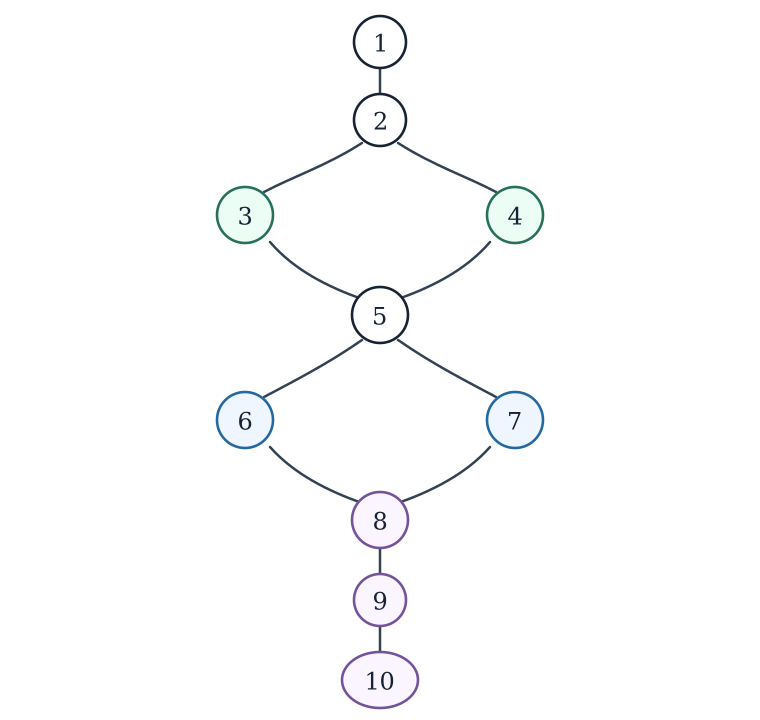
A dependency guide, not a required linear syllabus.
- Foundation
1 Quickstart · 2 Core Concepts
- Online Learning Routines
- Online Learning Algorithms
5 Choose an Algorithm · 6 D-RTRL · 7 pp-prop
- Internals and application
8 Operators for Online Learning · 9 RNN Compiler Walkthrough · 10 Examples and Advanced Topics
See also the BrainX ecosystem#
BrainTrace is part of BrainX, an open, differentiable ecosystem for full-scale brain simulation.