

Learning temporal order#
This experiment trains a small spiking circuit to identify which tone arrived first, reverses the requested label mapping without rebuilding the circuit, and continues the same plasticity process until the new rule is learned.
Prompt#
Teach a small spiking circuit to recognize which of two tones came first, then reverse their order and show how the circuit relearns.
Agent decision path#
Classify the model as a point-neuron circuit with event-driven online learning.
Route sensory, detector, and output neurons to
brainpy-stateand plastic communication tobrainevent.Build two sensory neurons, two trace-gated order detectors, and two output neurons.
Keep the detector layer fixed and make only detector-to-output weights plastic.
Train sequentially with nested
for_loopcalls so learned weights persist across trials.Reverse the teaching event while preserving the circuit and existing weights.
Construct independent evaluation batches with
vmapand native batch state.Verify acquisition, immediate reversal cost, relearning, and detector selectivity.
Result#
Accuracy moves from 50% untrained to 100% after acquisition, falls to 0% immediately after label reversal, and returns to 100% after relearning.
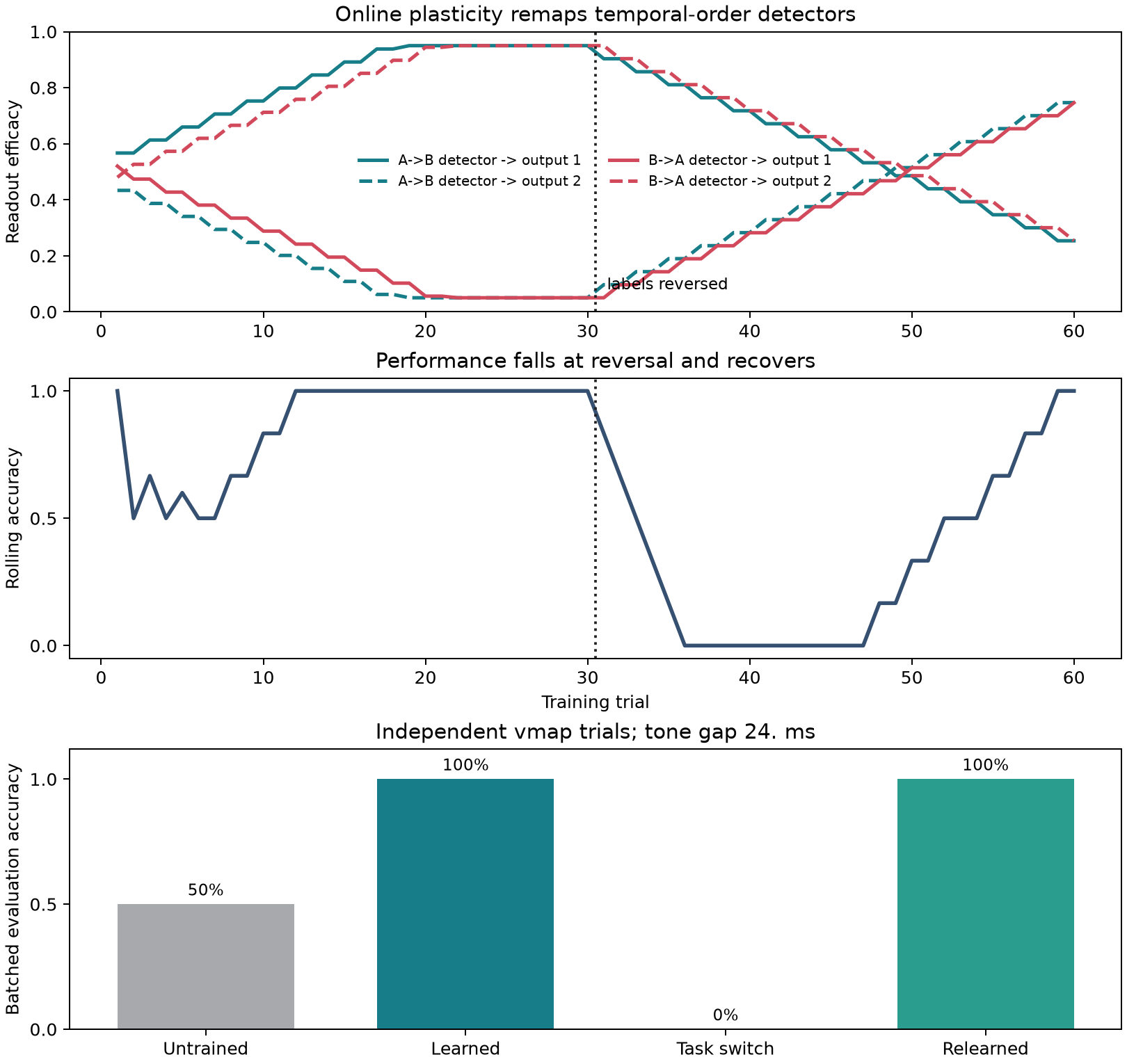
Fig. 9 The immediate failure after reversal establishes that the original mapping was learned; the later recovery shows plastic remapping in the same circuit.#
With-BrainX skill/Without skill comparison#
With BrainX skill
Source captured · benchmark pending
Measure training and evaluation separately while preserving sequential weight state, reversal timing, and independent evaluation state.
Without BrainX skill
Matched run not collected
Require the same four accuracy checkpoints and weight-remapping evidence before comparing implementation or runtime.