

Binocular rivalry#
This experiment models two continuously driven visual populations whose competition, fatigue, and noise produce alternating percepts. It maps the mechanism across a population of simulated observers instead of relying on one trace.
Prompt#
Model two competing visual populations, one seeing vertical stripes and the other horizontal stripes. Present both continuously so perception alternates between them, then simulate many observers with different adaptation and noise levels and explain what controls how long each percept dominates.
Agent decision path#
Classify the task as population-level perceptual competition.
Route competition to
brainmassand mutable adaptation and noise tobrainstate.Select two reduced Wong–Wang populations with mutual inhibition and equal continuous drive.
Add a slow self-adaptation current and Ornstein–Uhlenbeck current noise.
Define dominance with a fixed hysteresis threshold after a discarded transient.
Map 12 independent observers over a
5 x 5adaptation and noise grid.Use
for_loopfor time and state-awarevmapfor observer lanes.Store observer-level metrics and verify alternation, occupancy, and nonblank artifacts.
Result#
All 300 observers alternate. Mean dominance falls from 2.46 s to 1.29 s as adaptation increases and from 2.03 s to 1.43 s as noise increases. Equal drive produces 50.31% vertical occupancy.
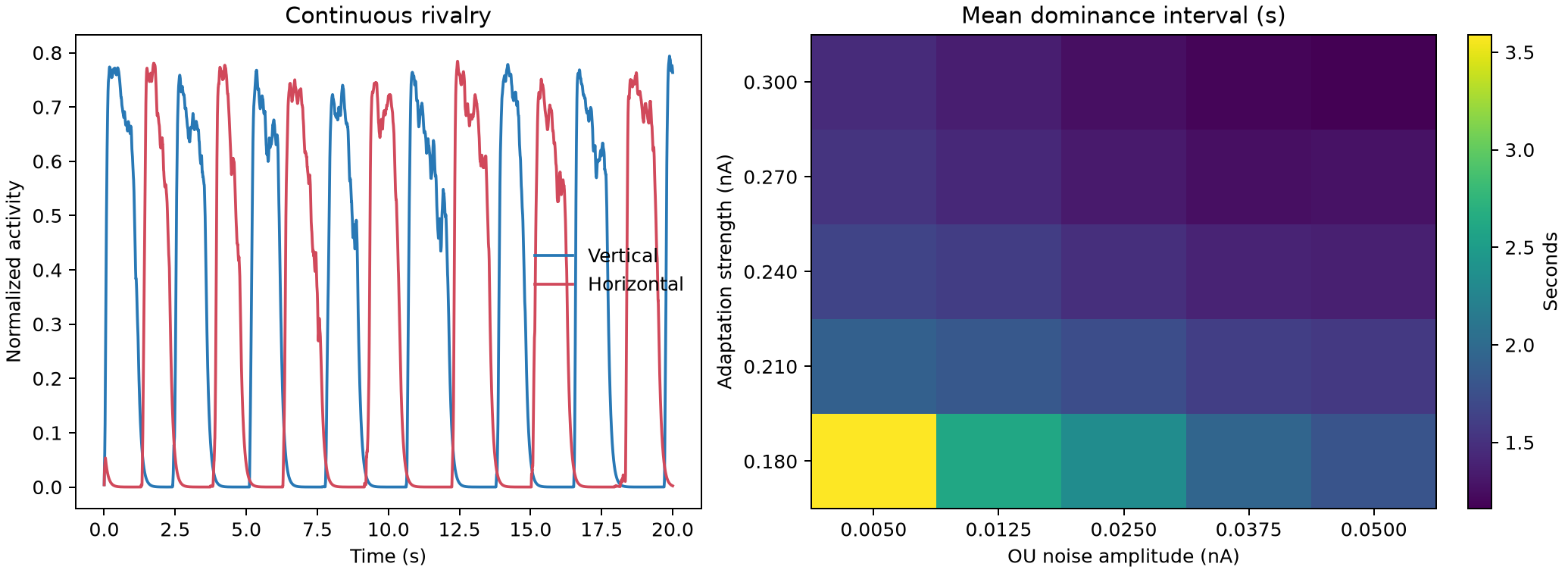
Fig. 4 Stronger adaptation accelerates winner fatigue; stronger noise increases escape from the current attractor.#
With-BrainX skill/Without skill comparison#
With BrainX skill
Source captured · benchmark pending
Benchmark the same 300 observers and retain alternation, occupancy, and dominance-duration checks with the runtime data.
Without BrainX skill
Matched run not collected
Hold the observer grid, random policy, analysis window, and dominance definition fixed.