
兴奋性-抑制性神经元网络(E-I网络)的模拟与分析#
本实例将基于 braincell 框架实现一个经典的兴奋-抑制神经元网络。通过构建由 Hodgkin-Huxley模型神经元组成的 E-I 网络,你将学习如何在 braincell 中实现从单神经元到网络的层级建模,并分析网络的 spike 动态特性。
准备工作#
首先确保已安装必要的库(braincell、brainstate、brainunit、matplotlib),并导入所需模块:
import brainpy
import brainunit as u
import matplotlib.pyplot as plt
import brainstate
import braincell
代码详解#
参数定义#
首先定义关键物理参数,这些参数决定了神经元的电生理特性和网络规模:
# 神经元动作电位发放阈值
V_th = -20. * u.mV

# 神经元膜面积
area = 20000 * u.um **2
area = area.in_unit(u.cm** 2)

# 膜电容
Cm = (1 * u.uF * u.cm ** -2) * area  # 总电容 = 比电容 × 面积
定义 HH 单神经元模型#
使用 SingleCompartment 构建基于 HH 模型的单神经元,包含钠通道 INa 、钾通道 IK 和漏电流 IL ,这些通道共同决定神经元的放电特性:
class HH(braincell.SingleCompartment):
    def __init__(self, in_size):
        # 初始化单房室神经元
        super().__init__(in_size, C=Cm, solver='ind_exp_euler')

        # 钠离子通道(INa)
        self.na = braincell.ion.SodiumFixed(in_size, E=50. * u.mV)
        self.na.add_elem(
            # 最大电导
            INa=braincell.channel.INa_TM1991(in_size, g_max=(100. * u.mS * u.cm **-2) * area, V_sh=-63. * u.mV)
        )

        # 钾离子通道(IK)
        self.k = braincell.ion.PotassiumFixed(in_size, E=-90 * u.mV)
        self.k.add_elem(
            # 最大电导
            IK=braincell.channel.IK_TM1991(in_size, g_max=(30. * u.mS * u.cm** -2) * area, V_sh=-63. * u.mV)
        )

        # 漏电流(IL)
        self.IL = braincell.channel.IL(
            in_size,
            E=-60. * u.mV,
            g_max=(5. * u.nS * u.cm **-2) * area  # 最大电导
        )
定义 E-I 网络:兴奋性与抑制性神经元的连接#
构建由兴奋性(E)和抑制性(I)神经元组成的网络,模拟皮层网络中常见的 E-I 平衡机制:
class EINet(brainstate.nn.Module):
    def __init__(self):
        super().__init__()
        # 网络规模
        self.n_exc = 3200
        self.n_inh = 800
        self.num = self.n_exc + self.n_inh  # 总神经元数:4000

        # 初始化神经元群体
        self.N = HH(self.num)

        # 兴奋性突触投射
        self.E = brainpy.state.AlignPostProj(
            # 连接规则
            comm=brainstate.nn.EventFixedProb(
                self.n_exc, self.num, conn_num=0.02,  # 连接概率
                conn_weight=6. * u.nS  # 突触权重
            ),
            # 突触动力学
            syn=brainpy.state.Expon(self.num, tau=5. * u.ms),
            # 突触后效应
            out=brainpy.state.COBA(E=0. * u.mV),
            post=self.N  # 投射目标为神经元群体 N
        )

        # 抑制性突触投射
        self.I = brainpy.state.AlignPostProj(
            # 连接规则
            comm=brainstate.nn.EventFixedProb(
                self.n_inh, self.num, conn_num=0.02,
                conn_weight=67. * u.nS
            ),
            # 突触动力学
            syn=brainpy.state.Expon(self.num, tau=10. * u.ms),
            # 突触后效应
            out=brainpy.state.COBA(E=-80. * u.mV),
            post=self.N  # 投射目标为神经元群体 N
        )

    def update(self, t):
        # 定义网络随时间的更新规则
        with brainstate.environ.context(t=t):
            # 获取当前时刻的 spike 信号
            spk = self.N.spike.value

            # 兴奋性神经元的 spike 驱动兴奋性突触投射
            self.E(spk[:self.n_exc])

            # 抑制性神经元的 spike 驱动抑制性突触投射
            self.I(spk[self.n_exc:])

            # 神经元接收突触输入后更新状态,返回新的 spike 信号
            spk = self.N(0. * u.nA)
运行网络模拟#
初始化网络并运行仿真,记录每个时刻的神经元 spike 活动:
# 初始化 E-I 网络
net = EINet()
brainstate.nn.init_all_states(net)  # 初始化网络中所有神经元和突触的状态

# 设置仿真参数并运行
with brainstate.environ.context(dt=0.1 * u.ms):  # 时间步长
    # 生成仿真时间序列
    times = u.math.arange(0. * u.ms, 100. * u.ms, brainstate.environ.get_dt())

    # 循环更新网络状态
    spikes = brainstate.transform.for_loop(
        net.update, times,
        pbar=brainstate.transform.ProgressBar(10)  # 显示进度条
    )
D:\Document\PyCharm\Project\braincell(collaborator)\.venv\Lib\site-packages\braintools\surrogate.py:72: UserWarning: Explicitly requested dtype float64 requested in asarray is not available, and will be truncated to dtype float32. To enable more dtypes, set the jax_enable_x64 configuration option or the JAX_ENABLE_X64 shell environment variable. See https://github.com/jax-ml/jax#current-gotchas for more.
  z = jnp.asarray(x >= 0, dtype=x.dtype)
Running for 1,000 iterations: 100%|██████████| 1000/1000 [00:00<00:00, 17183.01it/s]
可视化网络 spike 活动#
将 spike 数据绘制成格栅图,直观展示神经元在时间上的发放模式:
# 提取 spike 发生的时间和神经元索引
t_indices, n_indices = u.math.where(spikes)

# 绘制 raster plot
plt.scatter(times[t_indices], n_indices, s=1)
plt.xlabel('Time (ms)')  # 横轴:时间
plt.ylabel('Neuron index')  # 纵轴:神经元索引
plt.show()

# 此例程在jupyter中打断后无法完成可视化,暂时先将运行结果保留!
---------------------------------------------------------------------------
TypeError                                 Traceback (most recent call last)
Cell In[13], line 2
      1 # 提取 spike 发生的时间和神经元索引
----> 2 t_indices, n_indices = u.math.where(spikes)
      4 # 绘制 raster plot
      5 plt.scatter(times[t_indices], n_indices, s=1)

File D:\Document\PyCharm\Project\braincell(collaborator)\.venv\Lib\site-packages\saiunit\math\_fun_keep_unit.py:3305, in where(condition, x, y, size, fill_value)
   3303 if x is None and y is None:
   3304     assert not isinstance(fill_value, Quantity), "fill_value should not be a Quantity."
-> 3305     return jnp.where(condition, size=size, fill_value=fill_value)
   3307 assert size is None and fill_value is None, "size and fill_value are only supported when x and y are not None."
   3308 if isinstance(x, Quantity) and isinstance(y, Quantity):

File D:\Document\PyCharm\Project\braincell(collaborator)\.venv\Lib\site-packages\jax\_src\numpy\lax_numpy.py:2771, in where(condition, x, y, size, fill_value)
   2711 """Select elements from two arrays based on a condition.
   2712
   2713 JAX implementation of :func:`numpy.where`.
   (...)   2768   Array([0, 0, 0, 0, 0, 5, 6, 7, 8, 9], dtype=int32)
   2769 """
   2770 if x is None and y is None:
-> 2771   util.check_arraylike("where", condition)
   2772   return nonzero(condition, size=size, fill_value=fill_value)
   2773 else:

File D:\Document\PyCharm\Project\braincell(collaborator)\.venv\Lib\site-packages\jax\_src\numpy\util.py:183, in check_arraylike(fun_name, emit_warning, stacklevel, *args)
    180   warnings.warn(msg + " In a future JAX release this will be an error.",
    181                 category=DeprecationWarning, stacklevel=stacklevel)
    182 else:
--> 183   raise TypeError(msg.format(fun_name, type(arg), pos))

TypeError: where requires ndarray or scalar arguments, got <class 'NoneType'> at position 0.
结果解读#
运行代码后,你将看到一张格栅图,如下图:
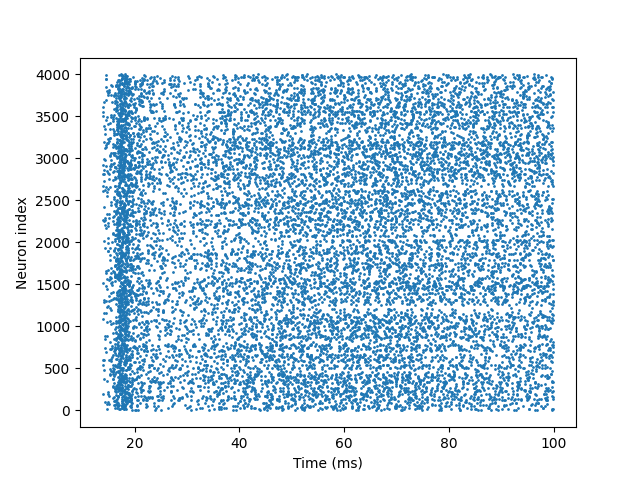
其中每个点代表一个神经元在特定时间的 spike 发放。典型的 E-I 网络动态具有以下特征:
异步发放:神经元发放时间分散,无明显同步节律。
稀疏活动:大多数神经元在 100 ms 内发放次数较少。
无爆发式同步:由于抑制性突触的快速反馈,避免了大规模神经元同步爆发。
这些特征表明 E-I 网络通过兴奋性和抑制性的动态平衡,维持了稳定且符合生理特性的活动模式。
扩展练习#
调整抑制性突触权重,观察网络是否出现过度同步,即爆发式活动。
增加兴奋性神经元比例,分析 E-I 失衡对网络动态的影响。
延长仿真时间,观察网络是否维持稳定的异步活动。
通过这些扩展,你可以深入理解 E-I 平衡在维持神经网络功能中的核心作用,以及 braincell 在复杂网络建模中的灵活性。