
Channels#
In biological neurons, ion channels control the permeability of ions such as sodium, potassium, and calcium, which form the basis of neural signal generation and transmission. Different types of channels have their own kinetic properties and influence changes in membrane potential.
Channel modeling in braincell has the following notable advantages:
Unified interface: whether it is a linear channel or a complex Markov model, all can be represented and integrated in a unified way.
High flexibility: supports multiple types of currents and allows user-defined modeling.
Compatible with
brainstate’s automatic differentiation system: each state variable can be precisely differentiated automatically, supporting efficient training and optimization.High extensibility: through inheritance and composition mechanisms, channel models can easily build subclasses, allowing parameter modification and extension.
braincell is highly flexible. For Channel, braincell supports two ways of use: defining new ion channels, or using existing ones.
Using existing channels#
Let’s first explain how to use existing channels.
According to different channel functions, we classify Channel into the following base classes:
Calcium ChannelsPotassium ChannelsSodium ChannelsPotassium Calcium ChannelsHyperpolarization-Activated ChannelsLeakage Channels
braincell has already built in many specific channels under each base class, and you can use them freely.
If you want to learn more about the built-in channels, you can check the Ion Channel Collection for details.
When modeling neurons in practice, whether using existing channels or custom ones, we need to call them. Of course, this call is quite simple, but we should also pay attention to some usage conventions.
Now let’s look at an example of modeling the HTC neuron:
import brainstate
import braintools
import brainunit as u
import matplotlib.pyplot as plt

import braincell
class HTC(braincell.SingleCompartment):
    def __init__(
        self,
        size,
        gKL=0.01 * (u.mS / u.cm ** 2),
        V_initializer=braintools.init.Constant(-65. * u.mV),
        solver: str = 'ind_exp_euler'
    ):
        super().__init__(size, V_initializer=V_initializer, V_th=20. * u.mV, solver=solver)

        self.area = 1e-3 / (2.9e-4 * u.cm ** 2)

        self.na = braincell.ion.SodiumFixed(size, E=50. * u.mV)
        self.na.add(INa=braincell.channel.INa_Ba2002(size, V_sh=-30 * u.mV))

        self.k = braincell.ion.PotassiumFixed(size, E=-90. * u.mV)
        self.k.add(IKL=braincell.channel.IK_Leak(size, g_max=gKL))
        self.k.add(IDR=braincell.channel.IKDR_Ba2002(size, V_sh=-30. * u.mV, phi=0.25))

        self.ca = braincell.ion.CalciumDetailed(
            size,
            C_rest=5e-5 * u.mM,
            tau=10. * u.ms,
            d=0.5 * u.um
        )
        self.ca.add(ICaL=braincell.channel.ICaL_IS2008(size, g_max=0.5 * (u.mS / u.cm ** 2)))
        self.ca.add(ICaN=braincell.channel.ICaN_IS2008(size, g_max=0.5 * (u.mS / u.cm ** 2)))
        self.ca.add(ICaT=braincell.channel.ICaT_HM1992(size, g_max=2.1 * (u.mS / u.cm ** 2)))
        self.ca.add(ICaHT=braincell.channel.ICaHT_HM1992(size, g_max=3.0 * (u.mS / u.cm ** 2)))

        self.kca = braincell.MixIons(self.k, self.ca)
        self.kca.add(IAHP=braincell.channel.IAHP_De1994(size, g_max=0.3 * (u.mS / u.cm ** 2)))

        self.Ih = braincell.channel.Ih_HM1992(size, g_max=0.01 * (u.mS / u.cm ** 2), E=-43 * u.mV)
        self.IL = braincell.channel.IL(size, g_max=0.0075 * (u.mS / u.cm ** 2), E=-70 * u.mV)
Through this example of the HTC neuron, it is clear that in practical modeling we only need to simply pass in the relevant channels.
It is worth noting, however, that the channels in this example have already been explicitly defined in the braincell codebase.
If you want to use other channels, you can either define your custom channels within the braincell codebase, or use import to bring in your custom channels.
Use of root_type#
When using each channel, we need to pay attention to the use of root_type. Generally speaking, calcium channels depend on the Calcium ion, potassium channels depend on the Potassium ion, and sodium channels depend on the Sodium ion.
braincell.channel.CalciumChannel.root_type
braincell.ion.Calcium
braincell.channel.PotassiumChannel.root_type
braincell.ion.Potassium
braincell.channel.SodiumChannel.root_type
braincell.ion.Sodium
Calcium-dependent potassium channels depend on both Potassium and Calcium ions.
braincell.channel.IAHP_De1994.root_type
JointTypes[braincell.ion.Potassium, braincell.ion.Calcium]
For some special channels, such as IL, they do not depend on any type of ion, so their root_type is the cell.
braincell.channel.IL.root_type
braincell.HHTypedNeuron
Adding ion channels#
When performing single-cell modeling, we usually need to add ion channels to ions. If the use of root_type is not handled correctly, ion channels may not work properly. For example, sodium channels can only be added to sodium ions, and potassium channels can only be added to potassium ions. If you try to add a sodium channel to potassium ions, or add a potassium channel to calcium ions, it will result in an error.
na = braincell.ion.SodiumFixed(1)
na.add(ina=braincell.channel.INa_HH1952(1))
try:
    na.add(ik=braincell.channel.IK_HH1952(1))
except Exception as e:
    print(e)
Type does not match. IK_HH1952(
  size=(1,),
  name=None,
  g_max=10. * msiemens / cmeter2,
  phi=1.0,
  V_sh=-45. * mvolt
) requires a root with type of <class 'braincell.ion.Potassium'>, but the root now is <class 'braincell.ion.SodiumFixed'>.
Simulating ion channels#
We can also directly simulate ion channels without adding them to ions. This allows for more flexible use of ion channels. However, when simulating ion channels, we need to provide the required information such as the neuron’s membrane potential and ion concentrations. Let’s take a calcium channel as an example.
ca = braincell.ion.CalciumFixed(1).pack_info()
V = -65 * u.mV

# The calcium channel to be simulated
can = braincell.channel.ICaL_IS2008(1)
can.init_state(V, ca)
def run_can(i):
    dt = 0.1 * u.ms
    t = i * dt
    with brainstate.environ.context(i=i, t=t, dt=dt):
        braincell.ind_exp_euler_step(can, t, dt, V, ca)
    return can.p.value, can.q.value


indices = u.math.arange(1000)
ps, qs = brainstate.transform.for_loop(run_can, indices)

plt.plot(indices, ps, label='$p$')
plt.plot(indices, qs, label='$q$')
plt.xlabel('Time (ms)')
plt.ylabel('State Value')
plt.title('ICaL IS2008 State Dynamics')
plt.legend()
plt.show()
---------------------------------------------------------------------------
TypeError                                 Traceback (most recent call last)
Cell In[41], line 10
      6     return can.p.value, can.q.value
      9 indices = u.math.arange(1000)
---> 10 ps, qs = brainstate.transform.for_loop(run_can, indices)
     12 plt.plot(indices, ps, label='$p$')
     13 plt.plot(indices, qs, label='$q$')

File D:\Document\PyCharm\Project\braincell(collaborator)\.venv\Lib\site-packages\brainstate\transform\_loop_collect_return.py:541, in for_loop(f, length, reverse, unroll, pbar, *xs)
    465 @set_module_as('brainstate.transform')
    466 def for_loop(
    467     f: Callable[..., Y],
   (...)    472     pbar: Optional[ProgressBar | int] = None
    473 ) -> Y:
    474     """
    475     ``for-loop`` control flow with :py:class:`~.State`.
    476
   (...)    539         >>> results = brainstate.transform.for_loop(process_item, xs, ys, reverse=True)
    540     """
--> 541     _, ys = scan(
    542         _forloop_to_scan_fun(f),
    543         init=None,
    544         xs=xs,
    545         length=length,
    546         reverse=reverse,
    547         unroll=unroll,
    548         pbar=pbar
    549     )
    550     return ys

File D:\Document\PyCharm\Project\braincell(collaborator)\.venv\Lib\site-packages\brainstate\transform\_loop_collect_return.py:248, in scan(f, init, xs, length, reverse, unroll, pbar)
    246 x_avals = [jax.core.mapped_aval(length, 0, aval) for aval in xs_avals]
    247 args = [init, xs_tree.unflatten(x_avals)]
--> 248 stateful_fun = StatefulFunction(f, name='scan').make_jaxpr(*args)
    249 state_trace = stateful_fun.get_state_trace(*args)
    250 all_writen_state_vals = state_trace.get_write_state_values(True)

File D:\Document\PyCharm\Project\braincell(collaborator)\.venv\Lib\site-packages\brainstate\transform\_make_jaxpr.py:1082, in StatefulFunction.make_jaxpr(self, *args, **kwargs)
   1080         self._cached_out_shapes.pop(cache_key, None)
   1081         self._cached_jaxpr.pop(cache_key, None)
-> 1082         raise e
   1084 return self

File D:\Document\PyCharm\Project\braincell(collaborator)\.venv\Lib\site-packages\brainstate\transform\_make_jaxpr.py:1060, in StatefulFunction.make_jaxpr(self, *args, **kwargs)
   1058     else:
   1059         dyn_kwargs[k] = v
-> 1060 jaxpr, (out_shapes, state_shapes) = _make_jaxpr(
   1061     functools.partial(
   1062         self._wrapped_fun_to_eval,
   1063         cache_key,
   1064         static_kwargs,
   1065     ),
   1066     static_argnums=self.static_argnums,
   1067     axis_env=self.axis_env,
   1068     return_shape=True,
   1069     abstracted_axes=self.abstracted_axes,
   1070 )(*args, **dyn_kwargs)
   1072 # returns
   1073 self._cached_jaxpr_out_tree.set(cache_key, jax.tree.structure((out_shapes, state_shapes)))

    [... skipping hidden 1 frame]

File D:\Document\PyCharm\Project\braincell(collaborator)\.venv\Lib\site-packages\brainstate\transform\_make_jaxpr.py:1996, in _make_jaxpr.<locals>.make_jaxpr_f(*args, **kwargs)
   1994         jaxpr, out_type, consts = pe.trace_to_jaxpr_dynamic2(f, debug_info=debug_info_)
   1995     else:
-> 1996         jaxpr, out_type, consts = pe.trace_to_jaxpr_dynamic2(f)
   1997 closed_jaxpr = ClosedJaxpr(jaxpr, consts)
   1998 if return_shape:

    [... skipping hidden 5 frame]

File D:\Document\PyCharm\Project\braincell(collaborator)\.venv\Lib\site-packages\brainstate\transform\_make_jaxpr.py:1006, in StatefulFunction._wrapped_fun_to_eval(self, cache_key, static_kwargs, *args, **dyn_kwargs)
   1004 self._cached_state_trace.set(cache_key, state_trace)
   1005 with state_trace:
-> 1006     out = self.fun(*args, **dyn_kwargs, **static_kwargs)
   1007     state_values = (
   1008         state_trace.get_write_state_values(True)
   1009         if self.return_only_write else
   1010         state_trace.get_state_values()
   1011     )
   1012 state_trace.recovery_original_values()

File D:\Document\PyCharm\Project\braincell(collaborator)\.venv\Lib\site-packages\brainstate\transform\_loop_collect_return.py:460, in _forloop_to_scan_fun.<locals>.scan_fun(carry, x)
    458 @wraps(f)
    459 def scan_fun(carry, x):
--> 460     return carry, f(*x)

Cell In[41], line 5, in run_can(i)
      3 t = i * dt
      4 with brainstate.environ.context(i=i, t=t, dt=dt):
----> 5     braincell.ind_exp_euler_step(can, t, dt, V, ca)
      6 return can.p.value, can.q.value

File D:\Document\PyCharm\Project\braincell(collaborator)\braincell\_integrator_exp_euler.py:229, in ind_exp_euler_step(target, excluded_paths, *args)
    226 dt = brainstate.environ.get('dt')
    228 # Pre-integration hook (e.g., update gating variables)
--> 229 target.pre_integral(*args)
    231 # Retrieve all states from the target module
    232 all_states, diffeq_states, other_states = split_diffeq_states(target)

TypeError: CalciumChannel.pre_integral() takes 3 positional arguments but 5 were given
Custom Channel Modeling#
Now let’s explain how to use custom channels.
In braincell, we use the IonChannel class as the base class for channel modeling. All specific channel models should inherit from this class.
IonChannel provides the following interfaces to support key operations during simulation:
current: compute the ionic current generated by the channel.init_state: initialize the channel’s state variables.reset_state: reset the channel’s state.compute_derivative: compute the derivatives of the channel’s internal state variables, used for the integrator.pre_integralandpost_integral: operations before/after integration, usually unused.
compute_derivative, pre_integral, and post_integral are the core interfaces for integration and are typically implemented in specific channels. For a detailed introduction, see the Differential Systems section. These methods integrate seamlessly with braincell’s differential system. When customizing ion channels, you need to properly set the relevant interfaces to achieve the desired functionality.
IonChannel contains both Ion and Channel. Therefore, we define a wrapper base class Channel that directly inherits from IonChannel. For semantic clarity, we recommend using Channel when developing practical channel models.
Once the Channel base class is in place, it’s time to build specific types of channels. In practice, we want subclasses of Channel to implement the necessary methods that define the behavior of specific channel types.
Now let’s go through how to build custom channels for different purposes.
Base Channel Modeling#
First, when modeling a new channel, we need to determine whether it belongs to one of the existing base channel categories.
As mentioned earlier, braincell classifies Channel into the following types:
Calcium ChannelsPotassium ChannelsSodium ChannelsPotassium Calcium ChannelsHyperpolarization-Activated ChannelsLeakage Channels
All of these channels directly inherit from the Channel base class. If the channel you want to customize belongs to one of these classes, refer directly to the following tutorials on subclass and specific channel modeling.
If your channel does not fit into these base classes, we will use the modeling of Calcium Channels as an example to show how to create a new base channel class.
In the braincell.channel module, all ion channels ultimately inherit from the unified abstract base class Channel. This class defines the minimal set of interfaces that every channel must implement, providing a unified framework for general modeling.
In practice, we often need to define intermediate base classes for different ion types. These type-specific base classes encapsulate channel type, input parameters, and interface structures, creating a clearer and more maintainable modeling hierarchy.
Here’s an example of modeling a Calcium Channel:
class CalciumChannel(braincell.Channel):
    # Specify the ion type this channel acts on
    root_type = braincell.ion.Calcium

    def pre_integral(self, V, Ca: braincell.IonInfo):
        pass

    def post_integral(self, V, Ca: braincell.IonInfo):
        pass

    def compute_derivative(self, V, Ca: braincell.IonInfo):
        pass

    def current(self, V, Ca: braincell.IonInfo):
        raise NotImplementedError

    def init_state(self, V, Ca: braincell.IonInfo, batch_size=None):
        pass

    def reset_state(self, V, Ca: braincell.IonInfo, batch_size=None):
        pass
The above code easily completes the modeling of CalciumChannel.
Looking at the code, the most important part is defining root_type = Calcium.
This is the core of CalciumChannel, which tells braincell:
this channel only acts on Calcium, and the parameter Ca must be of type IonInfo, representing the calcium ion state.
This ensures that when you implement interfaces such as current or compute_derivative, you can access the corresponding ion information.
Once you have defined CalciumChannel, all subsequent specific calcium channel subclasses can inherit from it:
at this point you no longer need to worry about the source of IonInfo, since braincell will automatically pass the Calcium ion to you.
At the same time, when modeling a new base channel class, you need to pay attention to defining its interfaces.
These interfaces can follow those defined in Channel, or they can be customized depending on actual needs.
By constructing type-specific base classes like CalciumChannel, we can:
Clearly specify the ion type applicable to the model.
Provide a unified interface.
Simplify the writing of downstream models.
Improve code reusability and maintainability.
This design also applies to sodium channels (SodiumChannel), potassium channels (PotassiumChannel), and other ion channels,
and it is recommended as the standard approach for writing custom channel models.
Specific Channel Modeling#
Next, let’s use the code for ICaT_HP1992 as an example to demonstrate how to define a custom ion channel model.
The ICaT_HP1992 ion channel is a calcium channel model, based on the calcium channel model proposed by Huguenard & Prince in 1992:
<A novel T-type current underlies prolonged Ca(2+)-dependent burst firing in GABAergic neurons of rat thalamic reticular nucleus>.
Modeling it only requires referring to the specific equations and implementing them directly in code.
First, we define the parameters:
\(p\) and \(q\) are two gating variables for activation and inactivation.
\(\phi_p = 5^{\frac{T-24}{10}}\) and \(\phi_q = 3^{\frac{T-24}{10}}\) are temperature-dependent factors (\(T\) is the temperature in Celsius).
\(E_{Ca}\) is the reversal potential of the calcium channel.
\(p_{\infty}\) and \(q_{\infty}\) are the steady-state activation/inactivation functions of \(p\) and \(q\) (voltage-dependent).
\(\tau_p\) and \(\tau_q\) are voltage-dependent time constants.
\(\phi_p\) and \(\phi_q\) are temperature correction factors.
\(g_{max}\) is the maximum conductance.
\(V\) is the membrane potential, and \(E_{Ca}\) is the calcium reversal potential.
\(V_{sh}\) is the membrane potential shift.
class ICaT_HP1992(CalciumChannel):
    root_type = braincell.ion.Calcium

    def __init__(
        self,
        size: brainstate.typing.Size,
        T: brainstate.typing.ArrayLike = u.celsius2kelvin(36.),
        T_base_p: brainstate.typing.ArrayLike = 5.,
        T_base_q: brainstate.typing.ArrayLike = 3.,
        g_max=1.75 * (u.mS / u.cm ** 2),
        V_sh=-3. * u.mV,
        phi_p=None,
        phi_q=None,
    ):
        super().__init__(size)

        T = u.kelvin2celsius(T)
        phi_p = T_base_p ** ((T - 24) / 10) if phi_p is None else phi_p
        phi_q = T_base_q ** ((T - 24) / 10) if phi_q is None else phi_q
        # parameters
        self.phi_p = braintools.init.param(phi_p, self.varshape, allow_none=False)
        self.phi_q = braintools.init.param(phi_q, self.varshape, allow_none=False)
        self.g_max = braintools.init.param(g_max, self.varshape, allow_none=False)
        self.T = braintools.init.param(T, self.varshape, allow_none=False)
        self.T_base_p = braintools.init.param(T_base_p, self.varshape, allow_none=False)
        self.T_base_q = braintools.init.param(T_base_q, self.varshape, allow_none=False)
        self.V_sh = braintools.init.param(V_sh, self.varshape, allow_none=False)
Then for \(p_{\infty}\) we have
    def f_p_inf(self, V):
        V = (V - self.V_sh).to_decimal(u.mV)
        return 1. / (1. + u.math.exp(-(V + 52.) / 7.4))
For \(\tau_p\) we have:
    def f_p_tau(self, V):
        V = (V - self.V_sh).to_decimal(u.mV)
        return 3. + 1. / (u.math.exp((V + 27.) / 10.) +
                          u.math.exp(-(V + 102.) / 15.))
For \(q_{\infty}\) we have:
    def f_q_inf(self, V):
        V = (V - self.V_sh).to_decimal(u.mV)
        return 1. / (1. + u.math.exp((V + 80.) / 5.))
For \(\tau_q\) we have:
    def f_q_tau(self, V):
        V = (V - self.V_sh).to_decimal(u.mV)
        return 85. + 1. / (u.math.exp((V + 48.) / 4.) + u.math.exp(-(V + 407.) / 50.))
At the same time, we need to set the state:
    def init_state(self, V, Ca: braincell.IonInfo, batch_size: int = None):
        self.p = braincell.DiffEqState(braintools.init.param(u.math.zeros, self.varshape, batch_size))
        self.q = braincell.DiffEqState(braintools.init.param(u.math.zeros, self.varshape, batch_size))
    def reset_state(self, V, Ca, batch_size=None):
        self.p.value = self.f_p_inf(V)
        self.q.value = self.f_q_inf(V)
        if batch_size is not None:
            assert self.p.value.shape[0] == batch_size
            assert self.q.value.shape[0] == batch_size
For \(\frac{dp}{dt}\) and \(\frac{dq}{dt}\), we have:
    def compute_derivative(self, V, Ca: braincell.IonInfo):
        self.p.derivative = self.phi_p * (self.f_p_inf(V) - self.p.value) / self.f_p_tau(V) / u.ms
        self.q.derivative = self.phi_q * (self.f_q_inf(V) - self.q.value) / self.f_q_tau(V) / u.ms
For the overall \(I_{CaT}\), we have:
    def current(self, V, Ca: braincell.IonInfo):
        return self.g_max * self.p.value * self.p.value * self.q.value * (Ca.E - V)
At this point, we have completed the modeling of ICaT_HP1992.
In braincell, we usually use __init__ to define the constructor, and during class initialization, we accept relevant parameters such as size, phi_p, phi_q, etc.
Additionally, we should use braintools.init.param to register phi_p, phi_q, and g_max as trainable parameters, which enables support for subsequent automatic differentiation, updates, and batch computations.
At the same time, when defining interfaces, we need to refer to the actual situation or the specific formulas; for example, the compute_derivative interface follows the specific formulas.
Through this modeling, the subclass channels gain the following functionalities:
Encapsulates the calcium current kinetics framework in the form of \(p^2 q\).
Manages the initialization, updating, and current calculation of the state variables \(p\) and \(q\).
Allows concrete parameters to be defined by the subclass.
Supports batch computation and parameter differentiability.
This modeling framework is highly versatile and flexible, suitable for various requirements encountered in practical modeling.
Existing Channel Examples#
After explaining how to use existing channels and create custom channels, we introduce some specific channel examples. Whether using built-in channels or creating new custom channels, these examples provide good references and can guide you when you have questions about channel modeling. The following channel examples show specific electrophysiological properties and modeling approaches.
Calcium Channels#
Electrophysiological Properties#
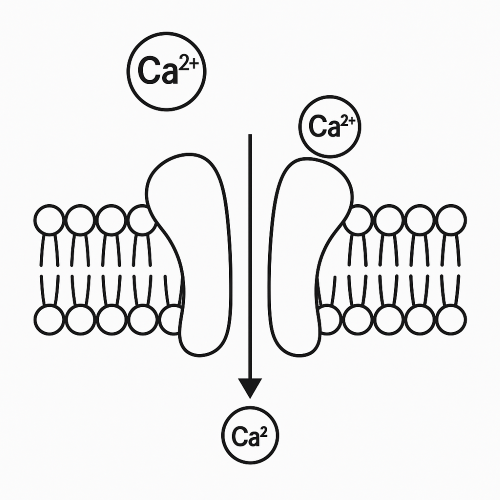
Calcium channels are highly important membrane channels responsible for regulating the transmembrane flow of calcium ions. Calcium ions in the nervous system not only participate in membrane potential changes but also play key roles in:
Action potential generation and maintenance: Certain neuron types rely on calcium channels to trigger or sustain firing rhythms.
Synaptic transmission: Calcium influx triggers neurotransmitter release.
Intracellular signaling: Calcium can regulate protein kinase activity, gene expression, enzymatic reactions, and more.
Calcium-dependent channel regulation: Many potassium or mixed channels are also regulated by calcium concentration.
Calcium channels typically exhibit slow activation, calcium-dependent inactivation, and high selectivity. They often work together with calcium pumps and buffering proteins to maintain calcium homeostasis.
Modeling Implementation#
In braincell, calcium channels are modeled by inheriting from CalciumChannel, which itself inherits from Channel and is part of the IonChannel system.
In practice, we need to implement relevant interfaces, such as current(V, Ca) and compute_derivative(V, Ca).
The Ca parameter is of type IonInfo and contains local calcium concentration information for the channel. Detailed information about IonInfo will be introduced in the Ion section.
Through these interfaces, we can build calcium channels with complex dynamics, such as dual voltage and calcium regulation, calcium-dependent inactivation, and steady-state activation gating.
After understanding the basic modeling, let’s look at a practical example: ICaN_IS2008.
This is a calcium-activated non-selective cation channel model proposed by Inoue & Strowbridge in 2008.
braincell follows a fixed naming convention for ion channels, in the format ChannelType_LiteratureID. Most channels in braincell follow this convention, which makes them easy to reference.
For the model itself, the current is described by the following formulas:
Where:
\(M\) is the calcium-dependent activation function
\(p\) is the voltage-gated activation variable
\(\phi\) is the temperature factor
\(E\) is the reversal potential
\(g_{\text{max}}\) is the maximal conductance
The following is the code implementation of this model:
class ICaN_IS2008(CalciumChannel):
    def __init__(
        self,
        size,
        E=10. * u.mV,
        g_max=1. * (u.mS / u.cm ** 2),
        phi=1.,
        name=None,
    ):
        super().__init__(size=size, name=name)
        self.E = braintools.init.param(E, self.varshape, allow_none=False)
        self.g_max = braintools.init.param(g_max, self.varshape, allow_none=False)
        self.phi = braintools.init.param(phi, self.varshape, allow_none=False)

    def init_state(self, V, Ca: braincell.IonInfo, batch_size: int = None):
        self.p = braincell.DiffEqState(braintools.init.param(u.math.zeros, self.varshape, batch_size))

    def reset_state(self, V, Ca: braincell.IonInfo, batch_size=None):
        V = V.to_decimal(u.mV)
        self.p.value = 1.0 / (1 + u.math.exp(-(V + 43.) / 5.2))

    def compute_derivative(self, V, Ca: braincell.IonInfo):
        V = V.to_decimal(u.mV)
        p_inf = 1.0 / (1 + u.math.exp(-(V + 43.) / 5.2))
        tau_p = 2.7 / (u.math.exp(-(V + 55.) / 15.) + u.math.exp((V + 55.) / 15.)) + 1.6
        self.p.derivative = self.phi * (p_inf - self.p.value) / tau_p / u.ms

    def current(self, V, Ca: braincell.IonInfo):
        M = Ca.C / (Ca.C + 0.2 * u.mM)
        g = self.g_max * M * self.p.value
        return g * (self.E - V)
In this example, we created a specific calcium channel subclass that inherits from CalciumChannel. Observing the code, we can see that CalciumChannel is very flexible when modeling a specific channel: you only need to set the relevant parameters and express the different interfaces in code according to the formulas.
Potassium Channels#
Electrophysiological Properties#
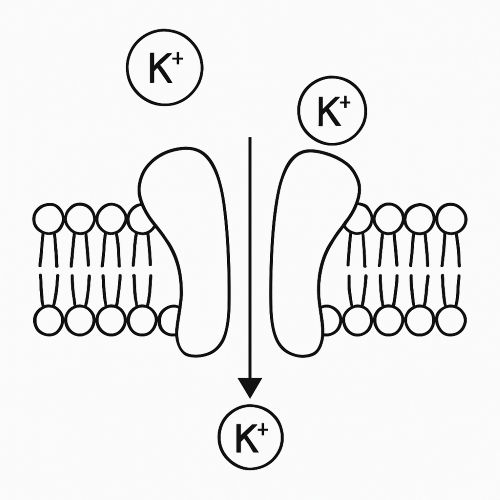
Potassium channels are the main hyperpolarizing channels in neurons, determining the repolarization process of action potentials and the stability of the resting membrane potential. Their functions in neurons include:
Action potential repolarization: During an action potential, sodium channels cause depolarization, and potassium channels open to allow K\(^+\) efflux, returning the membrane potential to resting levels.
Controlling excitability: Some potassium channels have delayed activation or calcium-dependent properties, regulating firing frequency, adaptation, and sustained excitability.
Modulating network rhythms: Certain potassium channels play important roles in rhythmic firing and oscillations.
Potassium channels have wide-ranging functions, and their kinetic modeling is crucial in computational neuroscience.
Modeling Implementation#
In braincell, potassium channels are modeled by inheriting from PotassiumChannel, which itself inherits from Channel.
When implementing a specific potassium channel, similar interfaces to those used for calcium channels are typically required.
Let’s look at a specific example: IKNI_Ya1989, which helps illustrate the approach.
This model was first proposed by Yamada in 1989 and represents a classic slow non-inactivating potassium channel used to explain frequency regulation during the afterhyperpolarization (AHP) period.
The model is described by the following formulas:
Where:
\(V\) is the membrane potential
\(E_K\) is the potassium reversal potential
\(\bar{g}_M\) is the maximal conductance
\(p\) is the gating variable
\(V_{\text{sh}}\) is the membrane potential shift
\(\tau_{\max}\) is the maximal time constant
\(p_{\infty}\) is the steady-state activation function
\(\tau_p\) is the activation time constant
The following is the code implementation:
from braincell.channel import PotassiumChannel


class IKNI_Ya1989(PotassiumChannel):
    def __init__(
        self,
        size,
        g_max=0.004 * (u.mS * u.cm ** -2),
        phi_p=1.,
        phi_q=1.,
        tau_max=4e3 * u.ms,
        V_sh=0. * u.mV,
        name=None,
    ):
        super().__init__(size=size, name=name)

        self.g_max = braintools.init.param(g_max, self.varshape, allow_none=False)
        self.tau_max = braintools.init.param(tau_max, self.varshape, allow_none=False)
        self.V_sh = braintools.init.param(V_sh, self.varshape, allow_none=False)
        self.phi_p = braintools.init.param(phi_p, self.varshape, allow_none=False)
        self.phi_q = braintools.init.param(phi_q, self.varshape, allow_none=False)

    def init_state(self, V, Ca: braincell.IonInfo, batch_size: int = None):
        self.p = braincell.DiffEqState(braintools.init.param(u.math.zeros, self.varshape, batch_size))

    def reset_state(self, V, K: braincell.IonInfo, batch_size=None):
        self.p.value = self.f_p_inf(V)
        if isinstance(batch_size, int):
            assert self.p.value.shape[0] == batch_size

    def compute_derivative(self, V, K: braincell.IonInfo):
        self.p.derivative = self.phi_p * (self.f_p_inf(V) - self.p.value) / self.f_p_tau(V)

    def current(self, V, K: braincell.IonInfo):
        return self.g_max * self.p.value * (K.E - V)

    def f_p_inf(self, V):
        V = (V - self.V_sh).to_decimal(u.mV)
        return 1. / (1. + u.math.exp(-(V + 35.) / 10.))

    def f_p_tau(self, V):
        V = (V - self.V_sh).to_decimal(u.mV)
        temp = V + 35.
        return self.tau_max / (3.3 * u.math.exp(temp / 20.) + u.math.exp(-temp / 20.))
From this example, we can see that PotassiumChannel provides a unified interface, and IKNI_Ya1989 can easily construct a biologically meaningful ion channel model using simple mathematical expressions.
In practical applications, we can further build subclasses under a subclass.
For example, first construct IKK2_pq_ss, which inherits from PotassiumChannel. Later, we can construct KK2A_HM1992 inheriting from IKK2_pq_ss and extend the original functionality of IKK2_pq_ss in KK2A_HM1992. This workflow facilitates large-scale modeling and improves efficiency. If you are interested in this part, you can refer to our Ion Channel Collection to see how braincell implements it in detail.
Sodium Channels#
Electrophysiological Properties#
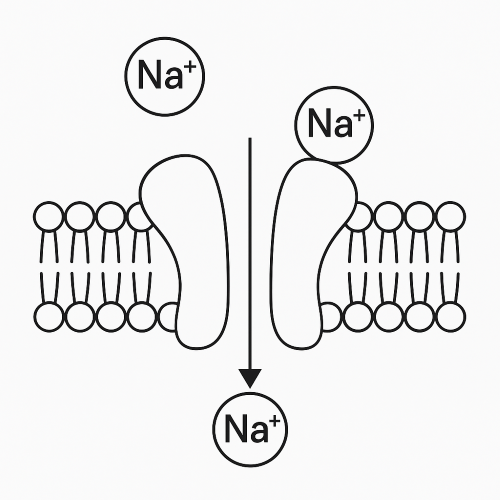
Sodium channels are indispensable excitatory channels in neurons, playing a central role in the initiation and rising phase of action potentials. When the membrane potential reaches a certain threshold, sodium channels rapidly activate, causing Na\(^+\) influx and rapid depolarization of the membrane.
Sodium channels have a typical dual-gate mechanism:
Activation gate: responds quickly to membrane potential changes, determining whether the channel opens.
Inactivation gate: responds slightly slower, closing the channel and causing inactivation.
This dual-gate structure allows sodium channels to exhibit fast activation and fast inactivation dynamics, which is the fundamental mechanism for the rapid rise and fall of action potentials.
Sodium channels are highly sensitive to membrane potential changes, and their kinetics determine the regulation of neuronal excitability. In the classical HH model, the sodium current is typically represented as:
Where:
\(m\) is the activation variable
\(h\) is the inactivation variable
\(g_{Na}\) is the maximal conductance
\(E_{Na}\) is the sodium reversal potential
Modeling Implementation#
In braincell, sodium channels are modeled by inheriting the SodiumChannel class, which, like the others, is a subclass of Channel.
As with calcium and potassium channels, we only need to define the corresponding interfaces to complete the modeling.
Here is a specific example: INa_p3q_markov.
Notably, a different channel naming convention is used here. INa_p3q_markov is named based on the formula structure, representing a current in the form of \(p^3 q\) and modeled using Markov kinetics. This is another naming convention in braincell: channel type_name_current form_model. Some ion channels adopt this convention.
INa_p3q_markov is a sodium channel model using Markov chain kinetics, where the current is controlled by activation variable \(p\) and inactivation variable \(q\):
Where:
\(p\) is the activation variable
\(q\) is the inactivation variable
\(\phi\) is the temperature factor
\(g_{max}\) is the maximal conductance
\(E_{Na}\) is the sodium reversal potential
The corresponding code implementation is as follows:
from braincell.channel import SodiumChannel


class INa_p3q_markov(SodiumChannel):
    def __init__(
        self,
        size,
        g_max=90. * (u.mS / u.cm ** 2),
        phi=1.,
        name=None,
    ):
        super().__init__(size=size, name=name)
        self.phi = braintools.init.param(phi, self.varshape, allow_none=False)
        self.g_max = braintools.init.param(g_max, self.varshape, allow_none=False)

    def init_state(self, V, Na: braincell.IonInfo, batch_size=None):
        self.p = braincell.DiffEqState(braintools.init.param(u.math.zeros, self.varshape, batch_size))
        self.q = braincell.DiffEqState(braintools.init.param(u.math.zeros, self.varshape, batch_size))

    def reset_state(self, V, Na: braincell.IonInfo, batch_size=None):
        self.p.value = self.f_p_alpha(V) / (self.f_p_alpha(V) + self.f_p_beta(V))
        self.q.value = self.f_q_alpha(V) / (self.f_q_alpha(V) + self.f_q_beta(V))

    def compute_derivative(self, V, Na: braincell.IonInfo):
        self.p.derivative = self.phi * (
            self.f_p_alpha(V) * (1. - self.p.value) - self.f_p_beta(V) * self.p.value) / u.ms
        self.q.derivative = self.phi * (
            self.f_q_alpha(V) * (1. - self.q.value) - self.f_q_beta(V) * self.q.value) / u.ms

    def current(self, V, Na: braincell.IonInfo):
        return self.g_max * self.p.value ** 3 * self.q.value * (Na.E - V)

    def f_p_alpha(self, V):
        raise NotImplementedError

    def f_p_beta(self, V):
        raise NotImplementedError

    def f_q_alpha(self, V):
        raise NotImplementedError

    def f_q_beta(self, V):
        raise NotImplementedError
Like the other two types of ion channels, our sodium channel modeling retains high flexibility.
Potassium Calcium Channels#
Electrophysiological Properties#
Potassium calcium (KCa) channels are widely present in neurons, and their activation depends not only on membrane potential but also on intracellular calcium concentration.
These channels play a crucial role in regulating neuronal excitability, afterhyperpolarization, and firing frequency. They are typically activated following calcium influx, promoting K\(^+\) efflux and returning the membrane potential to rest or hyperpolarized states.
Modeling Implementation#
Potassium calcium channels are commonly abbreviated as KCa channels in electrophysiology, and we adopt the same naming in modeling for code simplicity.
In braincell, KCa channels are modeled by directly inheriting the KCaChannel class, which is also a subclass of Channel.
As with the previously described channels, we only need to define the corresponding interfaces to complete the modeling.
Here we give an example: IAHP_De1994.
The IAHP_De1994 model, proposed by Destexhe et al. in 1994, inherits from KCaChannel and is used to simulate the dynamics of slow calcium-dependent potassium channels. The expressions are as follows:
Where:
\(p\) is the channel state variable
\(\alpha, \beta\) are the channel opening/closing rate constants
\(n\) is the number of calcium ions bound
\(\phi\) is the temperature factor
\(g_{\text{max}}\) is the maximal conductance
\(E_K\) is the potassium reversal potential
The code implementation is as follows:
from braincell.channel import KCaChannel


class IAHP_De1994(KCaChannel):
    def __init__(
        self,
        size: brainstate.typing.Size,
        n=2,
        g_max=10. * (u.mS / u.cm ** 2),
        alpha=48.,
        beta=0.09,
        phi=1.,
        name=None,
    ):
        super().__init__(size=size, name=name)
        self.g_max = braintools.init.param(g_max, self.varshape, allow_none=False)
        self.n = braintools.init.param(n, self.varshape, allow_none=False)
        self.alpha = braintools.init.param(alpha, self.varshape, allow_none=False)
        self.beta = braintools.init.param(beta, self.varshape, allow_none=False)
        self.phi = braintools.init.param(phi, self.varshape, allow_none=False)

    def init_state(self, V, K: braincell.IonInfo, Ca: braincell.IonInfo, batch_size=None):
        self.p = braincell.DiffEqState(braintools.init.param(u.math.zeros, self.varshape, batch_size))

    def reset_state(self, V, K: braincell.IonInfo, Ca: braincell.IonInfo, batch_size=None):
        C2 = self.alpha * u.math.power(Ca.C / u.mM, self.n)
        C3 = C2 + self.beta
        if batch_size is None:
            self.p.value = u.math.broadcast_to(C2 / C3, self.varshape)
        else:
            self.p.value = u.math.broadcast_to(C2 / C3, (batch_size,) + self.varshape)
            assert self.p.value.shape[0] == batch_size

    def compute_derivative(self, V, K: braincell.IonInfo, Ca: braincell.IonInfo):
        C2 = self.alpha * u.math.power(Ca.C / u.mM, self.n)
        C3 = C2 + self.beta
        self.p.derivative = self.phi * (C2 / C3 - self.p.value) * C3 / u.ms

    def current(self, V, K: braincell.IonInfo, Ca: braincell.IonInfo):
        return self.g_max * self.p.value * self.p.value * (K.E - V)
In fact, the modeling approach for these examples is highly consistent, with no differences in implementation.
Hyperpolarization-Activated Channels#
Electrophysiological Properties#
Hyperpolarization-activated channels are cation channels activated when the membrane potential hyperpolarizes. They play key regulatory roles in pacemaker neurons of the heart and certain types of central nervous system neurons:
Regulate resting membrane potential: depolarizing currents at rest stabilize the membrane potential and prevent excessive hyperpolarization.
Participate in rhythmic firing: in structures like the thalamus, they help maintain intrinsic rhythmic firing.
Excitability regulation: they can reduce neuronal input resistance, decreasing the cell’s sensitivity to inputs.
Modeling Implementation#
Since braincell does not have many built-in hyperpolarization-activated channels, we simply let specific hyperpolarization-activated channels inherit from the Channel class. This does not affect practical use.
Here is an example: Ih_HM1992.
Ih_HM1992 was proposed by Huguenard & McCormick in 1992 as a hyperpolarization-activated cation current model. Its dynamics are described by:
Where:
\(p\) is the activation variable
\(g_{\text{max}}\) is the maximal conductance
\(E\) is the reversal potential (about 43 mV)
\(\phi\) is the temperature factor
The code implementation is as follows:
from braincell import Channel


class Ih_HM1992(Channel):
    def __init__(
        self,
        size,
        g_max=10. * (u.mS / u.cm ** 2),
        E=43. * u.mV,
        phi=1.,
        name=None,
    ):
        super().__init__(size=size, name=name)
        self.phi = braintools.init.param(phi, self.varshape, allow_none=False)
        self.g_max = braintools.init.param(g_max, self.varshape, allow_none=False)
        self.E = braintools.init.param(E, self.varshape, allow_none=False)

    def init_state(self, V, batch_size=None):
        self.p = braincell.DiffEqState(braintools.init.param(u.math.zeros, self.varshape, batch_size))

    def reset_state(self, V, batch_size=None):
        self.p.value = self.f_p_inf(V)

    def compute_derivative(self, V):
        self.p.derivative = self.phi * (self.f_p_inf(V) - self.p.value) / self.f_p_tau(V) / u.ms

    def current(self, V):
        return self.g_max * self.p.value * (self.E - V)

    def f_p_inf(self, V):
        V = V.to_decimal(u.mV)
        return 1. / (1. + u.math.exp((V + 75.) / 5.5))

    def f_p_tau(self, V):
        V = V.to_decimal(u.mV)
        return 1. / (u.math.exp(-0.086 * V - 14.59) + u.math.exp(0.0701 * V - 1.87))
Through this example, you can see that modeling hyperpolarization-activated channels can be naturally integrated into the braincell framework. Using the Channel interface, their unique dynamics can be easily expressed.
Leakage Channels#
Electrophysiological Properties#
Leakage channels are a class of always-open ion channels whose permeability is not regulated by membrane potential, voltage gating, ligand binding, or other mechanisms. Electrophysiologically, leakage channels mainly maintain the resting membrane potential of neurons and are typically modeled as a linear conductance.
In the classic HH model, leakage currents primarily simulate background ionic flows that are not explicitly modeled, providing a stable baseline current.
Modeling Implementation#
In braincell, leakage channels are implemented by inheriting from LeakageChannel. Since leakage currents have no activation or inactivation gating variables, this type of channel does not need to implement differential processes like compute_derivative or init_state, making it relatively simple.
Here is a concrete example: IL, the most basic linear leakage channel, with the mathematical expression:
Where:
\(g_L\) is the leakage conductance (usually constant)
\(E_L\) is the leakage reversal potential
\(V\) is the membrane potential
The implementation code is also quite straightforward:
from braincell.channel import LeakageChannel


class IL(LeakageChannel):
    def __init__(
        self,
        size,
        g_max=0.1 * (u.mS / u.cm ** 2),
        E=-70. * u.mV,
        name=None,
    ):
        super().__init__(size=size, name=name)
        self.E = braintools.init.param(E, self.varshape, allow_none=False)
        self.g_max = braintools.init.param(g_max, self.varshape, allow_none=False)

    def current(self, V):
        return self.g_max * (self.E - V)
This IL class provides the simplest channel model. It does not involve any internal states or dynamics and represents a static conductance model, often used as a fundamental component in neuron models.