
Random Number Generation#
Random number generation is fundamental to machine learning and computational neuroscience. BrainState provides a comprehensive random number generation system built on JAX that combines:
🎲 NumPy-like API: Familiar interface for easy adoption
🔐 Reproducibility: Deterministic pseudorandom sequences
⚡ High Performance: JIT-compiled random functions
🔄 Stateful Management: Automatic key splitting and state handling
By the end of this tutorial, you will understand:
How to generate random numbers with BrainState
The
RandomStateclass and seed managementAvailable probability distributions
Random sampling and shuffling operations
Best practices for reproducible experiments
import brainstate
import numpy as np
import jax.numpy as jnp
import matplotlib.pyplot as plt
Why BrainState Random?#
JAX’s Challenge#
JAX uses explicit random keys for reproducibility and parallelization:
# JAX approach - manual key management
key = jax.random.PRNGKey(0)
key, subkey = jax.random.split(key)  # Must split manually
x = jax.random.normal(subkey, (100,))
This is powerful but verbose. BrainState simplifies this:
# BrainState approach - automatic key management
brainstate.random.seed(0)
x = brainstate.random.normal(0, 1, (100,))  # Keys handled automatically
Key Features#
✅ Automatic key splitting: No manual key management
✅ NumPy compatibility: Drop-in replacement for numpy.random
✅ Stateful interface: Natural imperative programming style
✅ JIT compatible: Full performance with JAX transformations
API Overview#
The brainstate.random module provides a wide range of functions for random number generation and sampling from probability distributions.
Category |
API Functions |
|---|---|
Random Sampling |
|
Continuous Distributions |
|
Discrete Distributions |
|
Shuffling |
|
Seed Management |
|
State Management |
|
The DEFAULT RandomState#
All random functions in brainstate.random use a global DEFAULT instance of RandomState:
# The DEFAULT random state
print("Default RandomState:")
print(brainstate.random.DEFAULT)
print(f"\nType: {type(brainstate.random.DEFAULT)}")
Default RandomState:
RandomState([7586 8057])

Type: <class 'brainstate.random._state.RandomState'>
Seed Management and Reproducibility#
Setting Seeds#
For reproducible experiments, always set a seed at the beginning:
# Set seed for reproducibility
brainstate.random.seed(42)
print("Seed set to 42")

# Generate some numbers
x1 = brainstate.random.rand(5)
print(f"First sequence: {x1}")

# Reset to same seed
brainstate.random.seed(42)
x2 = brainstate.random.rand(5)
print(f"Second sequence: {x2}")
print(f"\nIdentical? {jnp.allclose(x1, x2)}")
Seed set to 42
First sequence: [0.72766423 0.78786755 0.18169427 0.26263022 0.11072934]
Second sequence: [0.72766423 0.78786755 0.18169427 0.26263022 0.11072934]

Identical? True
Advanced: Key Management#
For advanced use cases, you can directly access and manipulate keys:
# Get current key
current_key = brainstate.random.get_key()
print(f"Current key: {current_key}")

# Split key for parallel operations
keys = brainstate.random.split_key(n=4)
print(f"\nSplit into {len(keys)} keys:")
for i, key in enumerate(keys):
    print(f"  Key {i}: {key}")
Current key: [1832780943  270669613]

Split into 4 keys:
  Key 0: [1705926158  899080142]
  Key 1: [4095997477  317277840]
  Key 2: [1820970612 3729538270]
  Key 3: [3985668294 1940518238]
# Save and restore state
saved_key = brainstate.random.get_key()
v1 = brainstate.random.randn(3)

# Generate more numbers
v2 = brainstate.random.randn(3)

# Restore state
brainstate.random.set_key(saved_key)
v3 = brainstate.random.randn(3)

print(f"v1: {v1}")
print(f"v2: {v2}")
print(f"v3 (restored): {v3}")
print(f"\nv1 == v3? {jnp.allclose(v1, v3)}")
v1: [-0.39489815 -0.42596528 -1.0719717 ]
v2: [ 0.6733885  -0.50893074 -0.28400496]
v3 (restored): [-0.39489815 -0.42596528 -1.0719717 ]

v1 == v3? True
Random Sampling#
Basic Sampling Functions#
# Uniform [0, 1)
brainstate.random.seed(42)
uniform_samples = brainstate.random.rand(5)
print("Uniform [0,1) samples:", uniform_samples)
Uniform [0,1) samples: [0.72766423 0.78786755 0.18169427 0.26263022 0.11072934]
# Standard normal (mean=0, std=1)
normal_samples = brainstate.random.randn(5)
print("Standard normal samples:", normal_samples)
Standard normal samples: [-0.21089035 -1.3627948 -0.04500385 -1.1536394 1.9141139 ]
# Random integers
int_samples = brainstate.random.randint(0, 10, size=5)
print("Random integers [0,10):", int_samples)
Random integers [0,10): [0 2 0 0 8]
Choice and Permutation#
# Random choice from array
options = jnp.array([10, 20, 30, 40, 50])
choices = brainstate.random.choice(options, size=3, replace=False)
print(f"Random choices from {options}:")
print(choices)
Random choices from [10 20 30 40 50]:
[40 50 20]
# Shuffle array
array = jnp.arange(10)
shuffled = brainstate.random.shuffle(array)
print(f"Original: {array}")
print(f"Shuffled: {shuffled}")
Original: [0 1 2 3 4 5 6 7 8 9]
Shuffled: [7 4 8 2 5 6 3 0 1 9]
# Random permutation
perm = brainstate.random.permutation(10)
print(f"Random permutation of 0-9: {perm}")
Random permutation of 0-9: [2 6 9 7 4 3 1 0 5 8]
Probability Distributions#
Continuous Distributions#
# Normal distribution
brainstate.random.seed(0)
normal_samples = brainstate.random.normal(loc=5.0, scale=2.0, size=1000)
print(f"Normal(μ=5, σ=2):")
print(f"  Mean: {jnp.mean(normal_samples):.3f} (expected: 5.0)")
print(f"  Std:  {jnp.std(normal_samples):.3f} (expected: 2.0)")
Normal(μ=5, σ=2):
  Mean: 4.941 (expected: 5.0)
  Std:  2.099 (expected: 2.0)
# Uniform distribution
uniform_samples = brainstate.random.uniform(low=0, high=10, size=1000)
print(f"\nUniform[0, 10):")
print(f"  Mean: {jnp.mean(uniform_samples):.3f} (expected: 5.0)")
print(f"  Min:  {jnp.min(uniform_samples):.3f}")
print(f"  Max:  {jnp.max(uniform_samples):.3f}")
Uniform[0, 10):
  Mean: 5.071 (expected: 5.0)
  Min:  0.012
  Max:  9.953
# Exponential distribution
exp_samples = brainstate.random.exponential(scale=2.0, size=1000)
print(f"\nExponential(λ=0.5):")
print(f"  Mean: {jnp.mean(exp_samples):.3f} (expected: 2.0)")

# Beta distribution
beta_samples = brainstate.random.beta(a=2.0, b=5.0, size=1000)
print(f"\nBeta(α=2, β=5):")
print(f"  Mean: {jnp.mean(beta_samples):.3f} (expected: {2/(2+5):.3f})")
Exponential(λ=0.5):
  Mean: 0.505 (expected: 2.0)

Beta(α=2, β=5):
  Mean: 0.292 (expected: 0.286)
Discrete Distributions#
# Binomial distribution
binomial_samples = brainstate.random.binomial(n=10, p=0.5, size=1000)
print(f"Binomial(n=10, p=0.5):")
print(f"  Mean: {jnp.mean(binomial_samples):.3f} (expected: 5.0)")
print(f"  Std:  {jnp.std(binomial_samples):.3f} (expected: {jnp.sqrt(10*0.5*0.5):.3f})")
Binomial(n=10, p=0.5):
  Mean: 5.024 (expected: 5.0)
  Std:  1.588 (expected: 1.581)
# Poisson distribution
poisson_samples = brainstate.random.poisson(lam=3.0, size=1000)
print(f"\nPoisson(λ=3):")
print(f"  Mean: {jnp.mean(poisson_samples):.3f} (expected: 3.0)")
print(f"  Var:  {jnp.var(poisson_samples):.3f} (expected: 3.0)")
Poisson(λ=3):
  Mean: 2.979 (expected: 3.0)
  Var:  2.949 (expected: 3.0)
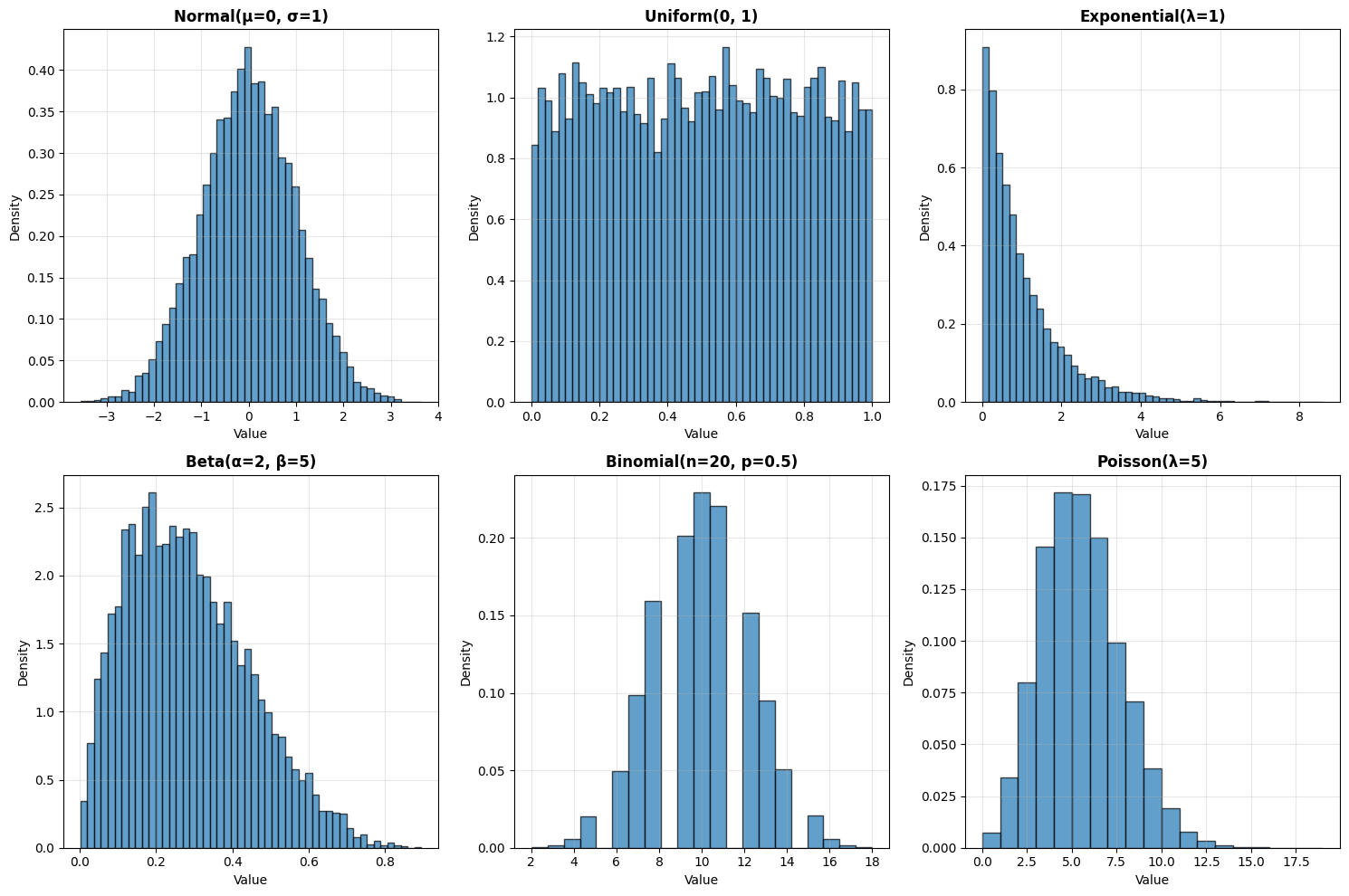
Visualizing Distributions#
Let’s visualize several distributions:
brainstate.random.seed(42)

fig, axes = plt.subplots(2, 3, figsize=(15, 10))

# Normal
samples = brainstate.random.normal(0, 1, 10000)
axes[0, 0].hist(np.array(samples), bins=50, density=True, alpha=0.7, edgecolor='black')
axes[0, 0].set_title('Normal(μ=0, σ=1)', fontsize=12, fontweight='bold')
axes[0, 0].set_xlabel('Value')
axes[0, 0].set_ylabel('Density')
axes[0, 0].grid(alpha=0.3)

# Uniform
samples = brainstate.random.uniform(0, 1, 10000)
axes[0, 1].hist(np.array(samples), bins=50, density=True, alpha=0.7, edgecolor='black')
axes[0, 1].set_title('Uniform(0, 1)', fontsize=12, fontweight='bold')
axes[0, 1].set_xlabel('Value')
axes[0, 1].set_ylabel('Density')
axes[0, 1].grid(alpha=0.3)

# Exponential
samples = brainstate.random.exponential(1.0, 10000)
axes[0, 2].hist(np.array(samples), bins=50, density=True, alpha=0.7, edgecolor='black')
axes[0, 2].set_title('Exponential(λ=1)', fontsize=12, fontweight='bold')
axes[0, 2].set_xlabel('Value')
axes[0, 2].set_ylabel('Density')
axes[0, 2].grid(alpha=0.3)

# Beta
samples = brainstate.random.beta(2, 5, 10000)
axes[1, 0].hist(np.array(samples), bins=50, density=True, alpha=0.7, edgecolor='black')
axes[1, 0].set_title('Beta(α=2, β=5)', fontsize=12, fontweight='bold')
axes[1, 0].set_xlabel('Value')
axes[1, 0].set_ylabel('Density')
axes[1, 0].grid(alpha=0.3)

# Binomial
samples = brainstate.random.binomial(20, 0.5, 10000)
axes[1, 1].hist(np.array(samples), bins=21, density=True, alpha=0.7, edgecolor='black')
axes[1, 1].set_title('Binomial(n=20, p=0.5)', fontsize=12, fontweight='bold')
axes[1, 1].set_xlabel('Value')
axes[1, 1].set_ylabel('Density')
axes[1, 1].grid(alpha=0.3)

# Poisson
samples = brainstate.random.poisson(5, 10000)
axes[1, 2].hist(np.array(samples), bins=range(0, 20), density=True, alpha=0.7, edgecolor='black')
axes[1, 2].set_title('Poisson(λ=5)', fontsize=12, fontweight='bold')
axes[1, 2].set_xlabel('Value')
axes[1, 2].set_ylabel('Density')
axes[1, 2].grid(alpha=0.3)

plt.tight_layout()
plt.show()
Custom RandomState Instances#
For advanced use cases, you can create custom RandomState instances with independent random streams:
# Create custom random generators
rng1 = brainstate.random.RandomState(42)
rng2 = brainstate.random.RandomState(123)

print("RNG 1:")
print(rng1)
RNG 1:
RandomState([ 0 42])
# Generate independent random sequences
samples1 = rng1.randn(5)
samples2 = rng2.randn(5)

print(f"Samples from RNG1: {samples1}")
print(f"Samples from RNG2: {samples2}")
print(f"\nAre they different? {not jnp.allclose(samples1, samples2)}")
Samples from RNG1: [ 0.60576403  0.7990441  -0.908927   -0.63525754 -1.2226585 ]
Samples from RNG2: [-0.7828054  -1.5373377  -0.5513038  -0.02385257  1.164293  ]

Are they different? True
# Re-seed custom RNG
rng1.seed(999)
samples3 = rng1.randn(5)
print(f"\nAfter re-seeding RNG1 to 999: {samples3}")
After re-seeding RNG1 to 999: [ 0.8200472 -0.35510033 -1.2458946 -0.33925015 -0.7285477 ]
Practical Examples#
Example 1: Mini-Batch Sampling#
def create_mini_batches(X, y, batch_size=32, shuffle=True):
    """Create mini-batches for training."""
    n_samples = len(X)

    # Shuffle indices
    if shuffle:
        indices = brainstate.random.permutation(n_samples)
    else:
        indices = jnp.arange(n_samples)

    # Create batches
    batches = []
    for start_idx in range(0, n_samples, batch_size):
        end_idx = min(start_idx + batch_size, n_samples)
        batch_indices = indices[start_idx:end_idx]
        batches.append((X[batch_indices], y[batch_indices]))

    return batches

# Generate dummy dataset
brainstate.random.seed(0)
X = brainstate.random.randn(100, 10)  # 100 samples, 10 features
y = brainstate.random.randint(0, 2, 100)  # Binary labels

# Create mini-batches
batches = create_mini_batches(X, y, batch_size=32)
print(f"Created {len(batches)} mini-batches")
print(f"First batch shape: X={batches[0][0].shape}, y={batches[0][1].shape}")
Created 4 mini-batches
First batch shape: X=(32, 10), y=(32,)
Example 2: Dropout Layer#
class Dropout(brainstate.nn.Module):
    """Dropout layer with random masking."""

    def __init__(self, drop_rate=0.5):
        super().__init__()
        self.drop_rate = drop_rate

    def __call__(self, x):
        fit = brainstate.environ.get('fit', False)
        if not fit:
            return x

        # Generate random mask
        keep_prob = 1.0 - self.drop_rate
        mask = brainstate.random.bernoulli(keep_prob, x.shape)

        # Apply dropout and scale
        return x * mask / keep_prob

# Test dropout
brainstate.random.seed(42)
dropout = Dropout(drop_rate=0.3)

x = jnp.ones(10)
y = dropout(x)

print(f"Input:  {x}")
print(f"Output: {y}")
print(f"Zeros:  {jnp.sum(y == 0)}/10")
Input:  [1. 1. 1. 1. 1. 1. 1. 1. 1. 1.]
Output: [1. 1. 1. 1. 1. 1. 1. 1. 1. 1.]
Zeros:  0/10
Example 3: Noisy Neural Network#
class NoisyLayer(brainstate.nn.Module):
    """Linear layer with Gaussian noise."""

    def __init__(self, d_in, d_out, noise_std=0.1):
        super().__init__()
        self.noise_std = noise_std

        # Parameters with noise
        self.w = brainstate.ParamState(brainstate.random.randn(d_in, d_out) * 0.1)
        self.b = brainstate.ParamState(jnp.zeros(d_out))

    def __call__(self, x):
        # Add weight noise
        w_noisy = self.w.value + brainstate.random.normal(0, self.noise_std, self.w.value.shape)

        # Forward pass
        return x @ w_noisy + self.b.value

# Create and test
brainstate.random.seed(0)
layer = NoisyLayer(5, 3, noise_std=0.01)

x = jnp.ones(5)
y1 = layer(x)
y2 = layer(x)  # Different due to noise

print(f"Output 1: {y1}")
print(f"Output 2: {y2}")
print(f"Difference: {y2 - y1}")
Output 1: [-0.29487485 -0.37535232 -0.19899406]
Output 2: [-0.30561778 -0.33523202 -0.16594572]
Difference: [-0.01074293  0.0401203   0.03304833]
Best Practices#
1. Always Set Seeds for Reproducibility#
# At the start of your script/notebook
brainstate.random.seed(42)
2. Use Custom RNGs for Independent Streams#
# For data augmentation
aug_rng = brainstate.random.RandomState(seed=123)

# For model initialization
init_rng = brainstate.random.RandomState(seed=456)
3. Save and Restore State for Checkpoints#
# Save state
checkpoint = {
    'model': model.state_dict(),
    'rng_key': brainstate.random.get_key()
}

# Restore state
brainstate.random.set_key(checkpoint['rng_key'])
Summary#
In this tutorial, you learned:
✅ Seed management for reproducible experiments
✅ Random sampling with various distributions
✅ Custom RandomState instances for independent streams
✅ Practical applications in neural networks
✅ Best practices for random number generation
Key Points#
🎲 BrainState provides a NumPy-like interface to JAX’s random system
🔐 Always set seeds for reproducibility
⚡ Random functions are JIT-compatible and high-performance
🔄 State is automatically managed for you
Next Steps#
Continue with:
Neural Network Modules - Use random initialization in models
Program Transformations - Combine randomness with JIT, vmap, and grad
Training Loops - Implement stochastic gradient descent