

Simulation and Analysis of Excitatory-Inhibitory Neuronal Networks (E-I Networks)#
This example demonstrates the implementation of a classical excitatory-inhibitory (E-I) neuronal network using the braincell framework. By constructing an E-I network composed of Hodgkin-Huxley model neurons, you will learn how to implement hierarchical modeling from single neurons to networks in braincell, and analyze the spike dynamics of the network.
Preparation#
First, ensure that the necessary libraries (braincell, brainstate, brainunit, matplotlib) are installed, and import the required modules:
import brainpy
import brainunit as u
import matplotlib.pyplot as plt
import brainstate
import braincell
An NVIDIA GPU may be present on this machine, but a CUDA-enabled jaxlib is not installed. Falling back to cpu.
Code Explanation#
Parameter Definition#
First, define the key biophysical parameters, which determine the electrophysiological properties of the neurons and the network size:
# Neuron action potential firing threshold
V_th = -20. * u.mV

# Neuron membrane area
area = 20000 * u.um **2
area = area.in_unit(u.cm** 2)

# Membrane capacitance
Cm = (1 * u.uF * u.cm ** -2) * area  # Total capacitance = specific capacitance × area
Define HH single neuron model#
Use SingleCompartment to construct a single neuron based on the HH model, including sodium channel INa, potassium channel IK, and leak current IL. These channels jointly determine the firing properties of the neuron:
class HH(braincell.SingleCompartment):
    def __init__(self, in_size):
        # Initialize single-compartment neuron
        super().__init__(in_size, C=Cm, solver='ind_exp_euler')

        # Sodium channel (INa)
        self.na = braincell.ion.SodiumFixed(in_size, E=50. * u.mV)
        self.na.add(
            # Maximum conductance
            INa=braincell.channel.Na_TM1991(in_size, g_max=(100. * u.mS * u.cm **-2) * area, V_sh=-63. * u.mV)
        )

        # Potassium channel (IK)
        self.k = braincell.ion.PotassiumFixed(in_size, E=-90 * u.mV)
        self.k.add(
            # Maximum conductance
            IK=braincell.channel.K_TM1991(in_size, g_max=(30. * u.mS * u.cm** -2) * area, V_sh=-63. * u.mV)
        )

        # Leak current (IL)
        self.IL = braincell.channel.IL(
            in_size,
            E=-60. * u.mV,
            g_max=(5. * u.nS * u.cm **-2) * area  # Maximum conductance
        )
Define E-I Network: Connections Between Excitatory and Inhibitory Neurons#
Construct a network composed of excitatory (E) and inhibitory (I) neurons to simulate the commonly observed E-I balance mechanism in cortical networks:
class EINet(brainstate.nn.Module):
    def __init__(self):
        super().__init__()
        # Network scale
        self.n_exc = 3200
        self.n_inh = 800
        self.num = self.n_exc + self.n_inh  # Total number of neurons: 4000

        # Initialize neuron population
        self.N = HH(self.num)

        # Excitatory synaptic projection
        self.E = brainpy.state.AlignPostProj(
            # Connection rule
            comm=brainstate.nn.EventFixedProb(
                self.n_exc, self.num, conn_num=0.02,  # Connection probability
                conn_weight=6. * u.nS  # Synaptic weight
            ),
            # Synaptic dynamics
            syn=brainpy.state.Expon(self.num, tau=5. * u.ms),
            # Postsynaptic effect
            out=brainpy.state.COBA(E=0. * u.mV),
            post=self.N  # Projection target is neuron population N
        )

        # Inhibitory synaptic projection
        self.I = brainpy.state.AlignPostProj(
            # Connection rule
            comm=brainstate.nn.EventFixedProb(
                self.n_inh, self.num, conn_num=0.02,
                conn_weight=67. * u.nS
            ),
            # Synaptic dynamics
            syn=brainpy.state.Expon(self.num, tau=10. * u.ms),
            # Postsynaptic effect
            out=brainpy.state.COBA(E=-80. * u.mV),
            post=self.N  # Projection target is neuron population N
        )

    def update(self, t):
        # Define network update rules over time
        with brainstate.environ.context(t=t):
            # Get spike signals at current time
            spk = self.N.spike.value

            # Spikes from excitatory neurons drive excitatory synaptic projection
            self.E(spk[:self.n_exc])

            # Spikes from inhibitory neurons drive inhibitory synaptic projection
            self.I(spk[self.n_exc:])

            # Neurons update their states after receiving synaptic inputs, return new spike signals
            spk = self.N(0. * u.nA)

            return spk
Run network simulation#
Initialize the network and run the simulation, recording the spike activity of neurons at each time point:
# Initialize E-I network
net = EINet()
brainstate.nn.init_all_states(net)  # Initialize the states of all neurons and synapses in the network

# Set simulation parameters and run
with brainstate.environ.context(dt=0.1 * u.ms):  # Time step
    # Generate simulation time sequence
    times = u.math.arange(0. * u.ms, 100. * u.ms, brainstate.environ.get_dt())

    # Loop to update network states
    spikes = brainstate.transform.for_loop(
        net.update, times,
        pbar=brainstate.transform.ProgressBar(10)  # Display progress bar
    )
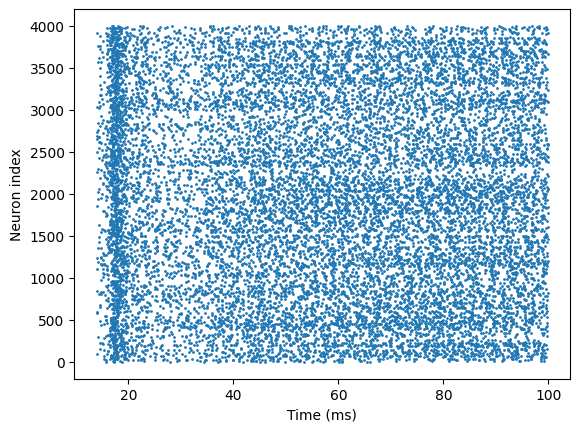
Visualize network spike activity#
Plot the spike data as a raster plot to intuitively show the firing patterns of neurons over time:
# Extract spike times and neuron indices
t_indices, n_indices = u.math.where(spikes)

# Plot raster plot
plt.scatter(times[t_indices] / u.ms, n_indices, s=1)
plt.xlabel('Time (ms)')  # X-axis: time
plt.ylabel('Neuron index')  # Y-axis: neuron index
plt.show()
Results Interpretation#
After running the code, you will see a raster plot, as shown below:
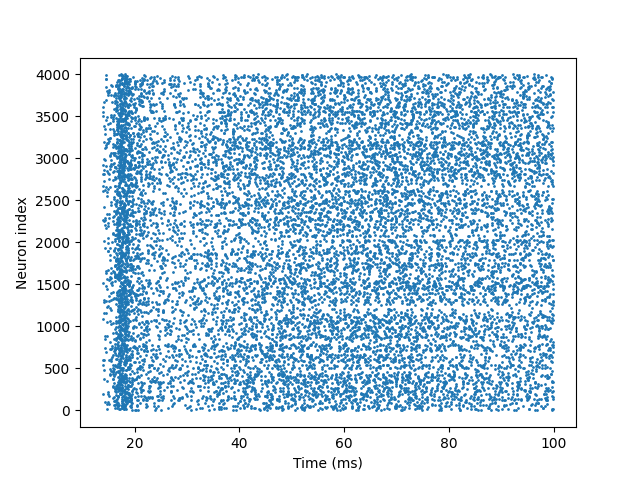
Each point represents a spike fired by a neuron at a specific time. Typical dynamics of an E-I network have the following characteristics:
Asynchronous firing: Neurons fire at dispersed times without obvious synchronous rhythms.
Sparse activity: Most neurons fire only a few times within 100 ms.
No burst synchronization: Rapid feedback from inhibitory synapses prevents large-scale synchronous bursting.
These features indicate that the E-I network maintains a stable and physiologically realistic activity pattern through dynamic balance between excitatory and inhibitory neurons.
Extended Exercises#
Adjust inhibitory synaptic weights and observe whether the network exhibits excessive synchronization or bursting activity.
Increase the proportion of excitatory neurons to analyze the impact of E-I imbalance on network dynamics.
Extend the simulation duration to see if the network maintains stable asynchronous activity.
Through these extensions, you can gain deeper insights into the critical role of E-I balance in maintaining neural network function, and the flexibility of braincell in modeling complex networks.