

Mechanisms in BrainCell#
This notebook now stays intentionally narrow.
Ion and Channel already have dedicated walkthroughs in 6.channel.ipynb and 7.ion.ipynb. Here we only keep the minimum density background needed to make point mechanisms concrete, then spend most of the notebook on probes.
At the declaration layer, the current multi-compartment mechanism surface still splits into two families:
Density: installed withcell.paint(region, ...)Point: installed withcell.place(locset, ...)
CableProperty is closely related, but it is a passive cable declaration rather than a Mechanism subclass.
Family |
Declaration |
Attach with |
What matters most |
Coverage here |
|---|---|---|---|---|
Passive cable declaration |
|
|
Passive defaults such as |
Short reminder |
Density mech |
|
|
Runtime ion containers and ion-side state |
See |
Density mech |
|
|
Distributed conductance mechanisms bound to ions |
See |
Point mech |
|
|
Current injection at point locations |
Short refresher |
Point mech |
|
|
Read runtime state and current back out of the cell |
Main focus |
Point mech |
|
|
Older or narrower workflows |
Overview only |
import os

os.environ.setdefault("JAX_PLATFORMS", "cpu")
os.environ.setdefault("MPLBACKEND", "Agg")

import brainunit as u
import matplotlib.pyplot as plt

from braincell import Branch, Cell, Morphology
from braincell.filter import AllRegion, BranchSlice, RootLocation, Terminals, at
from braincell.mech import (
    CableProperty,
    Channel,
    CurrentClamp,
    CurrentProbe,
    FunctionClamp,
    Ion,
    MechanismProbe,
    SineClamp,
    StateProbe,
)


def build_demo_morphology() -> Morphology:
    soma = Branch.from_lengths(
        lengths=[20.0] * u.um,
        radii=[8.0, 8.0] * u.um,
        type="soma",
    )
    dend = Branch.from_lengths(
        lengths=[60.0] * u.um,
        radii=[2.0, 1.2] * u.um,
        type="basal_dendrite",
    )
    axon = Branch.from_lengths(
        lengths=[80.0] * u.um,
        radii=[1.0, 0.6] * u.um,
        type="axon",
    )
    morpho = Morphology.from_root(soma, name="soma")
    morpho.attach(parent="soma", child_branch=dend, child_name="dend", parent_x=1.0)
    morpho.attach(parent="soma", child_branch=axon, child_name="axon", parent_x=0.0)
    return morpho
1. Density declarations: only the minimum background#
The density side has three layers:
CablePropertysets passive cable defaults.Iondeclares ion containers and any ion-side runtime state.Channelinstalls distributed mechanisms that bind to those ions.
For the full density story, use the neighboring notebooks instead of this one:
4.cell.ipynbfor the paint/place workflow onCell6.channel.ipynbfor channel templates, gates, and generated ODEs7.ion.ipynbfor ion templates, Nernst handling, and dynamic ion state
That is enough context for probes, because probes only become interesting after Cell.init_state() has materialized runtime state from these declarations.
1.1 CableProperty: paintable, central, but passive#
CableProperty uses the same paint(...) entry point as density mechanisms, so it still belongs in the mental model even though it does not inherit from Mechanism.
morpho = build_demo_morphology()
print(morpho.topo())

cell_passive = Cell(morpho)
cell_passive.paint(
    AllRegion(),
    CableProperty(
        resting_potential=-65.0 * u.mV,
        membrane_capacitance=1.0 * (u.uF / u.cm**2),
        axial_resistivity=100.0 * (u.ohm * u.cm),
    ),
)

print()
print(cell_passive)
print("root CV resting potential:", cell_passive.cvs[0].v)
soma
├── dend
└── axon

Cell(root='soma', n_branches=3, n_paint_rules=1, n_place_rules=0, initialized=False)
root CV resting potential: -65. mV
2. Point mechanisms: stimuli versus observers#
Point mechanisms live at one location in the point tree rather than across a branch interval.
For this notebook, the useful split is:
stimuli: declarations that inject current at one point
observers: declarations that read runtime values back out of the cell
Locsets decide where those declarations land. If you want the full locset vocabulary, see 2.filter.ipynb.
2.1 Clamp declarations: a quick refresher#
CurrentClamp, SineClamp, and FunctionClamp all feed the same runtime path: cell.runtime.evaluate_point_clamps(t=...).
If several clamps are placed at the same point, their currents add. Since the rest of this notebook is probe-focused, we only keep one short runnable refresher here.
cell_clamp = Cell(build_demo_morphology())
cell_clamp.place(
    RootLocation(x=0.5),
    CurrentClamp(
        delay=0.0 * u.ms,
        durations=(2.0 * u.ms, 2.0 * u.ms),
        amplitudes=(0.0 * u.nA, 0.3 * u.nA),
    ),
    SineClamp(
        amplitude=0.2 * u.nA,
        frequency=500.0 * u.Hz,
        offset=0.1 * u.nA,
        duration=4.0 * u.ms,
    ),
    FunctionClamp(
        fn=lambda t: 0.4 * u.nA if t < 1.0 * u.ms else 0.0 * u.nA,
    ),
)
cell_clamp.init_state()

point_index = int(cell_clamp.layouts[0].point_index[0])
current_early = cell_clamp.runtime.evaluate_point_clamps(t=0.5 * u.ms)
current_late = cell_clamp.runtime.evaluate_point_clamps(t=2.5 * u.ms)

print("layout kinds:", [layout.kind for layout in cell_clamp.layouts])
print("active point index:", point_index)
print(f"combined clamp current at 0.5 ms: {float(current_early[point_index].to_decimal(u.nA)):.3f} nA")
print(f"combined clamp current at 2.5 ms: {float(current_late[point_index].to_decimal(u.nA)):.3f} nA")
layout kinds: ['CurrentClamp', 'SineClamp', 'FunctionClamp']
active point index: 1
combined clamp current at 0.5 ms: 0.700 nA
combined clamp current at 2.5 ms: 0.600 nA
2.2 Probes: the main observer surface#
Probes are sparse point declarations. They do not allocate their own evolving state; they sample state or current that already exists elsewhere in the initialized runtime.
The three public probe types are:
StateProbe: reads cell-owned state. In the current multi-compartment implementation, that means membrane voltagev.MechanismProbe: reads a runtime state field from a named mechanism or ion.CurrentProbe: reads the current of a named mechanism, or the total current of a named ion owner.
Once cell.init_state() has run, you can read probes in two ways:
cell.sample_probe(name)reads one probe snapshot by name.cell.sample_probes()reads every probe snapshot as a{name: value}dictionary.
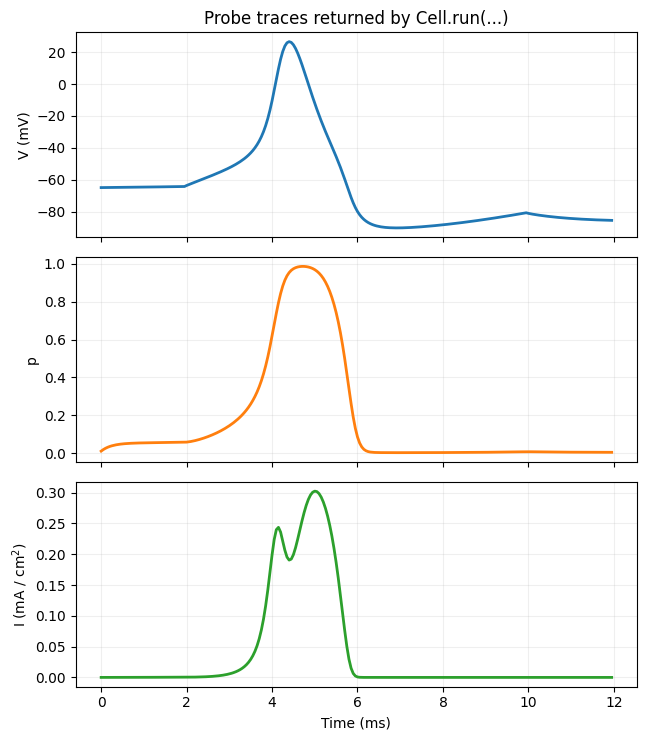
During time integration, cell.run(...) samples the same placed probes every timestep and returns them in RunResult.traces.
cell_probe = Cell(build_demo_morphology())
region = BranchSlice(branch_index=[0, 1], prox=0.0, dist=1.0)

cell_probe.paint(
    region,
    Channel("IL", g_max=0.03 * (u.mS / u.cm**2), E=-54.387 * u.mV),
    Channel("Na_HH1952", g_max=120.0 * (u.mS / u.cm**2)),
    Ion(
        "CalciumDetailed",
        name="ca_dyn",
        d=0.5 * u.um,
        tau=10.0 * u.ms,
        C_rest=5.0e-5 * u.mM,
        Ci_initializer=2.4e-4 * u.mM,
    ),
)
cell_probe.paint(
    BranchSlice(branch_index=0, prox=0.0, dist=1.0),
    Channel("CaT_HM1992", ion_name="ca_dyn", g_max=2.0 * (u.mS / u.cm**2)),
)

cell_probe.place(
    at("soma", 0.5),
    StateProbe(),
    MechanismProbe(mechanism="Na_HH1952", field="p"),
    MechanismProbe(mechanism="ca_dyn", field="Ci"),
    CurrentProbe(ion="na", mechanism="Na_HH1952"),
    CurrentProbe(ion="na"),
    CurrentProbe(mechanism="IL"),
)
cell_probe.init_state()

samples = cell_probe.sample_probes()

print("probe keys:", sorted(samples))
print("single lookup via sample_probe:", float(cell_probe.sample_probe("soma(0.5)_Na_HH1952_p")))
print("soma(0.5)_v (mV):", float(samples["soma(0.5)_v"].to_decimal(u.mV)))
print("soma(0.5)_Na_HH1952_p:", float(samples["soma(0.5)_Na_HH1952_p"]))
print("soma(0.5)_ca_dyn_Ci (mM):", float(samples["soma(0.5)_ca_dyn_Ci"].to_decimal(u.mM)))
print(
    "soma(0.5)_Na_HH1952_current (mA / cm^2):",
    float(samples["soma(0.5)_Na_HH1952_current"].to_decimal(u.mA / u.cm**2)),
)
print(
    "soma(0.5)_na_current (mA / cm^2):",
    float(samples["soma(0.5)_na_current"].to_decimal(u.mA / u.cm**2)),
)
print(
    "soma(0.5)_IL_current (mA / cm^2):",
    float(samples["soma(0.5)_IL_current"].to_decimal(u.mA / u.cm**2)),
)
probe keys: ['soma(0.5)_IL_current', 'soma(0.5)_Na_HH1952_current', 'soma(0.5)_Na_HH1952_p', 'soma(0.5)_ca_dyn_Ci', 'soma(0.5)_na_current', 'soma(0.5)_v']
single lookup via sample_probe: 0.0
soma(0.5)_v (mV): -65.0
soma(0.5)_Na_HH1952_p: 0.0
soma(0.5)_ca_dyn_Ci (mM): 0.00024
soma(0.5)_Na_HH1952_current (mA / cm^2): 0.0
soma(0.5)_na_current (mA / cm^2): 0.0
soma(0.5)_IL_current (mA / cm^2): 0.00031838996801525354
2.3 What can a probe measure, exactly?#
The practical rules are:
StateProbe(field="v")reads cell-owned membrane voltage. In the current implementation,vis the only supported state field.MechanismProbe(mechanism="Na_HH1952", field="p")works well for channel gate variables and other runtime state stored asbrainstate.State.MechanismProbealso works on ion names, not only on channel names. That is whyMechanismProbe(mechanism="ca_dyn", field="Ci")can read the dynamic calcium concentration created byIon("CalciumDetailed", name="ca_dyn", ...).Static parameters are not valid probe fields. For example,
g_maxis a parameter, not runtime state.Derived properties are not valid probe fields either. For Nernst-style ions,
Eis computed from the current ion state; it is not stored as a standalone runtimeState.CurrentProbe(ion="na", mechanism="Na_HH1952")reads one mechanism current.CurrentProbe(mechanism="IL")reads a mechanism current when the mechanism can evaluatecurrent(...)without an explicit ion selector.CurrentProbe(ion="na")reads the total current of the named ion owner.
In the snapshot above, soma(0.5)_Na_HH1952_current and soma(0.5)_na_current happen to match because only one sodium channel is present. Once several sodium channels share the same ion owner, the ion-total probe becomes their sum.
Probe names matter because every runtime lookup is name-keyed:
If you do not provide
name=..., the lowerer auto-generates names such assoma(0.5)_vorsoma(0.5)_Na_HH1952_p.If you do provide
name=..., it must still be globally unique. Duplicate names will makesample_probes()andrun(...)ambiguous.
morpho_multi = build_demo_morphology()
locset = RootLocation(x=0.5) | Terminals()

cell_multi = Cell(morpho_multi)
cell_multi.place(locset, StateProbe())
cell_multi.init_state()

print("locset display names:", morpho_multi.select(locset).display_names)
print("resolved probe keys:", sorted(cell_multi.sample_probes()))
print()
for layout in cell_multi.layouts:
    declaration = cell_multi.runtime.get_layout_mechanism(layout.id)
    print(layout.kind, layout.point_index.tolist(), declaration.name)
locset display names: ('soma(0.5)', 'dend(1)', 'axon(1)')
resolved probe keys: ['axon(1)_v', 'dend(1)_v', 'soma(0.5)_v']

state_probe:v:soma(0.5)_v [1] soma(0.5)_v
state_probe:v:dend(1)_v [4] dend(1)_v
state_probe:v:axon(1)_v [6] axon(1)_v
A locset that resolves to several points therefore produces several probes, one per selected point, each with its own resolved name. That is usually what you want for sample_probes() and for RunResult.traces, because each trace stays keyed by one concrete point location.
2.4 CurrentProbe on mixed-ion channels: owner versus modulators#
Mixed-ion channels need one more piece of vocabulary.
Kca3p1_MA2020_GoC uses potassium as the current owner, while calcium acts as a modulator of the gating dynamics. In that case:
CurrentProbe(mechanism="Kca3p1_MA2020_GoC")asks the mechanism itself for its current, using all ions that were bound to it at runtime.CurrentProbe(ion="k_main")asks the potassium owner for its total current, which may include several potassium channels.
To make that distinction visible, the example below adds a second potassium channel and briefly depolarizes the soma before comparing the two recorded currents.
cell_mixed = Cell(build_demo_morphology())
region = BranchSlice(branch_index=[0, 1], prox=0.0, dist=1.0)

cell_mixed.paint(
    region,
    Ion("PotassiumFixed", name="k_main", E=-88.0 * u.mV),
    Ion("CalciumFixed", name="ca_hva", Ci=2e-4 * u.mM),
    Ion("CalciumFixed", name="ca_lva", Ci=5e-4 * u.mM),
)
cell_mixed.paint(
    region,
    Channel("Kca3p1_MA2020_GoC", ion_names={"ca": "ca_hva"}),
    Channel("K_Kv_test", ion_name="k_main", g_max=1.0 * (u.mS / u.cm**2)),
)
cell_mixed.place(
    RootLocation(x=0.5),
    CurrentClamp(delay=0.5 * u.ms, durations=10.0 * u.ms, amplitudes=0.5 * u.nA),
)
cell_mixed.place(
    at("soma", 0.5),
    CurrentProbe(mechanism="Kca3p1_MA2020_GoC"),
    CurrentProbe(ion="k_main"),
)

result = cell_mixed.run(dt=0.05 * u.ms, duration=11.0 * u.ms)
layout = next(layout for layout in cell_mixed.layouts if layout.kind == "channel:Kca3p1_MA2020_GoC")
mech_trace = result.traces["soma(0.5)_Kca3p1_MA2020_GoC_current"].to_decimal(u.mA / u.cm**2)
total_trace = result.traces["soma(0.5)_k_main_current"].to_decimal(u.mA / u.cm**2)

print(sorted(result.traces))
print("bound ion keys:", cell_mixed.runtime.bound_ion_keys[layout.id])
print("current owner:", cell_mixed.runtime.current_owner_keys[layout.id])
print("last Kca mechanism current (mA / cm^2):", float(mech_trace[-1]))
print("last k_main total current (mA / cm^2):", float(total_trace[-1]))
print("difference at last timestep (mA / cm^2):", float(total_trace[-1] - mech_trace[-1]))
['soma(0.5)_Kca3p1_MA2020_GoC_current', 'soma(0.5)_k_main_current']
bound ion keys: ('k_main', 'ca_hva')
current owner: k_main
last Kca mechanism current (mA / cm^2): -0.026092058047652245
last k_main total current (mA / cm^2): -0.02650710940361023
difference at last timestep (mA / cm^2): -0.0004150513559579849
2.5 Probe traces during cell.run(...)#
Snapshots are useful when you want the value now. For a time series, you do not place a different declaration: you place the same probes and then call cell.run(...).
A few operational details matter:
cell.run(...)auto-callsinit_state()if the cell is still in DECLARING.cell.run(...)requires at least one placed probe, because its trace output is probe-driven.The return value is
RunResult(time=..., traces=...), wheretracesis a dictionary keyed by probe name.
Below we drive the soma with a step current and record three traces from the same point: membrane voltage, one sodium gate variable, and the sodium mechanism current.
sim_cell = Cell(build_demo_morphology())
sim_region = BranchSlice(branch_index=[0, 1], prox=0.0, dist=1.0)

sim_cell.paint(
    sim_region,
    Channel("IL", g_max=0.03 * (u.mS / u.cm**2), E=-54.387 * u.mV),
    Channel("Na_HH1952", g_max=120.0 * (u.mS / u.cm**2)),
    Channel("K_HH1952", g_max=36.0 * (u.mS / u.cm**2)),
)

sim_cell.place(
    RootLocation(x=0.5),
    CurrentClamp(delay=2.0 * u.ms, durations=8.0 * u.ms, amplitudes=0.2 * u.nA),
)
sim_cell.place(
    at("soma", 0.5),
    StateProbe(),
    MechanismProbe(mechanism="Na_HH1952", field="p"),
    CurrentProbe(ion="na", mechanism="Na_HH1952"),
)

result = sim_cell.run(dt=0.05 * u.ms, duration=12.0 * u.ms)

print("trace keys:", sorted(result.traces))
print("n timesteps:", int(result.time.shape[0]))
print("current time after run (ms):", float(sim_cell.current_time.to_decimal(u.ms)))

fig, axes = plt.subplots(3, 1, figsize=(6.5, 7.5), sharex=True)

times_ms = result.time.to_decimal(u.ms)
axes[0].plot(times_ms, result.traces["soma(0.5)_v"].to_decimal(u.mV), color="#1f77b4", linewidth=2.0)
axes[0].set_ylabel("V (mV)")
axes[0].set_title("Probe traces returned by Cell.run(...)")
axes[0].grid(True, alpha=0.2)

axes[1].plot(times_ms, result.traces["soma(0.5)_Na_HH1952_p"], color="#ff7f0e", linewidth=2.0)
axes[1].set_ylabel("p")
axes[1].grid(True, alpha=0.2)

axes[2].plot(
    times_ms,
    result.traces["soma(0.5)_Na_HH1952_current"].to_decimal(u.mA / u.cm**2),
    color="#2ca02c",
    linewidth=2.0,
)
axes[2].set_xlabel("Time (ms)")
axes[2].set_ylabel("I (mA / cm$^2$)")
axes[2].grid(True, alpha=0.2)

plt.tight_layout()
plt.show()
trace keys: ['soma(0.5)_Na_HH1952_current', 'soma(0.5)_Na_HH1952_p', 'soma(0.5)_v']
n timesteps: 240
current time after run (ms): 12.0
2.6 Other point declarations#
Three public point declarations are worth knowing even though this notebook does not build their full workflows.
ProbeMechanism(variable="v", target="soma")is the older variable-by-name recorder. For new multi-compartment code, preferStateProbe,MechanismProbe, andCurrentProbewhen you want explicit selectors.Synapse(synapse_type="AMPA", ...)is the registry-keyed synapse declaration surface.Junction(...)is the current placeholder for gap-junction-style point declarations.
Summary#
The mechanism surface in the current multi-compartment stack is still small, but the probe story is already quite usable:
CableProperty,Ion, andChannelcreate the runtime objects that probes later observe.StateProbeis the voltage probe: today it supports onlyv.MechanismProbereads named runtime state on a channel or ion, as long as the field is a real runtimeState.CurrentProbecan read one mechanism current or one ion owner’s total current.cell.sample_probe(...)andcell.sample_probes()give immediate snapshots afterinit_state().cell.run(...)records the same placed probes over time and returns them by probe name inRunResult.traces.
For more declaration detail, continue with 6.channel.ipynb and 7.ion.ipynb. For more locset detail, continue with 2.filter.ipynb.