

How to choose a neuron model#
Task. Pick the right spiking neuron model for your network and see how a few of them respond to the same input.
Audience. Simulation. Assumes you’ve done Tutorial 1 · Your first neuron.
brainpy.state ships a family of point-neuron models, from the minimal
integrate-and-fire to biophysical Hodgkin–Huxley. They all share the same
interface — construct with a size and parameters, advance with a call, read
spikes with get_spike() — so swapping one for another is a one-line change.
This guide drives several under an identical current so you can compare their
firing behavior, then points you to the full list in the API reference.
import brainpy
import brainstate
import braintools
import brainunit as u
import matplotlib.pyplot as plt
An NVIDIA GPU may be present on this machine, but a CUDA-enabled jaxlib is not installed. Falling back to cpu.
Drive several models with the same current#
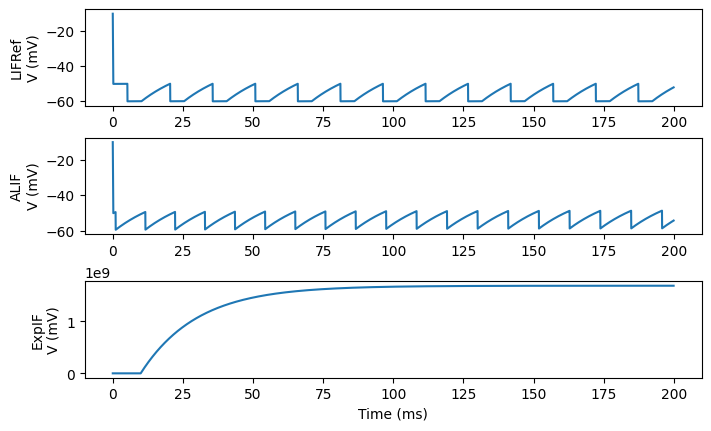
We build one neuron of each kind, give them all the same step current, and record their membrane potentials. Each model has its own natural parameter units and scales, so we keep parameters close to each model’s defaults.
def run(neuron, current, t_stop=200. * u.ms):
    brainstate.nn.init_all_states(neuron)

    def step(t):
        with brainstate.environ.context(t=t):
            neuron(current)
            return neuron.V.value

    times = u.math.arange(0. * u.ms, t_stop, brainstate.environ.get_dt())
    return times, brainstate.transform.for_loop(step, times)


with brainstate.environ.context(dt=0.05 * u.ms):
    models = {
        'LIFRef': brainpy.state.LIFRef(
            1, tau=20. * u.ms, tau_ref=5. * u.ms, V_rest=-60. * u.mV,
            V_th=-50. * u.mV, V_reset=-60. * u.mV),
        'ALIF': brainpy.state.ALIF(
            1, tau=20. * u.ms, tau_a=200. * u.ms, V_rest=-60. * u.mV,
            V_th=-50. * u.mV, V_reset=-60. * u.mV),
        'ExpIF': brainpy.state.ExpIF(
            1, tau=20. * u.ms, V_rest=-60. * u.mV, V_reset=-60. * u.mV),
    }
    traces = {name: run(m, 25. * u.mA) for name, m in models.items()}
Compare the responses#
fig, gs = braintools.visualize.get_figure(len(traces), 1, 1.4, 7.0)
for i, (name, (times, vs)) in enumerate(traces.items()):
    ax = fig.add_subplot(gs[i, 0])
    ax.plot(times.to_decimal(u.ms), vs.to_decimal(u.mV)[:, 0])
    ax.set_ylabel(name + '\nV (mV)')
ax.set_xlabel('Time (ms)')
plt.show()
Choosing a model#
LIFRef (leaky integrate-and-fire with a refractory period) fires regularly;
ALIF adds spike-frequency adaptation (the inter-spike interval grows over
time); ExpIF has a sharper, exponential spike onset. Choose based on the
phenomenon you need:
Minimal cost:
IF,LIF,LIFRef.Adaptation:
ALIF,Gif,AdExIF,AdQuaIF.Realistic spike onset:
ExpIF,AdExIF,QuaIF.Rich single-neuron dynamics:
Izhikevich,HindmarshRose.Full biophysics:
HH,WangBuzsakiHH,MorrisLecar.
Where to find every model#
This is only a sample. The authoritative directory — with every neuron’s full signature, parameters, and equations — is the API reference:
BrainPy-style Neurons — all BrainPy-style neuron models.
See also#
How to choose between COBA and CUBA synapses — connect your chosen neurons with synapses.
Model anatomy — the shared
Dynamics → Neuroninterface.Tutorial 3 · An E/I balanced network — a full network built from LIFRef.