

Record and analyze#
What you’ll learn / who it’s for (simulation). The recording API tour: tap spikes with a spike_recorder and analog signals with a multimeter, read the data back, and analyze it — firing rate, raster, spike times in two formats, and the inter-spike-interval (ISI) coefficient of variation.
Ported from examples/nest_like/recording_demo.py. Recording is in memory — there is no file backend yet — so NEST’s record_to backend axis collapses to the in-memory equivalent.
import jax
jax.config.update('jax_enable_x64', True)
import brainstate
brainstate.environ.set(precision=64)

import numpy as np
import brainunit as u
import matplotlib.pyplot as plt
from brainpy import state as bp
An NVIDIA GPU may be present on this machine, but a CUDA-enabled jaxlib is not installed. Falling back to cpu.
A trivial network to record from#
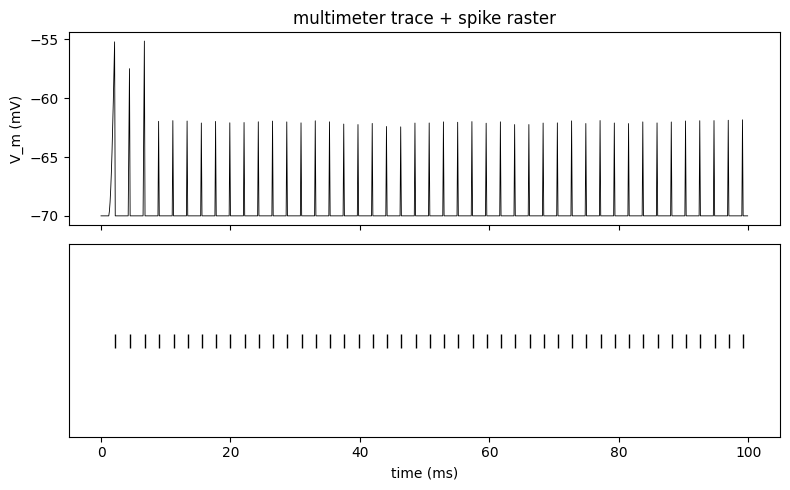
A single poisson_generator drives one iaf_psc_exp. We attach two recorders: a spike_recorder for spikes and a multimeter recording V_m at the simulation resolution. The high (1 MHz) drive saturates the neuron so it fires every refractory period — a steady stream of spikes to analyze.
dt = 0.1
sim = bp.Simulator(dt=dt * u.ms)
neuron = sim.create(bp.iaf_psc_exp, 1)
pg = sim.create(bp.poisson_generator, 1, rate=1_000_000. * u.Hz, rng_seed=0)
sr = sim.create(bp.spike_recorder)
mm = sim.create(bp.multimeter, record_from=['V_m'], interval=dt * u.ms)

sim.connect(pg, neuron, weight=10. * u.pA, delay=1.0 * u.ms)
sim.connect(neuron, sr)             # spike tap
sim.connect(mm, neuron)             # reversed: the multimeter observes the neuron

res = sim.simulate(100. * u.ms)
Spike statistics: rate and event count#
res.rate(sr) is the mean firing rate (Hz) and res.n_events(sr) the total spike count.
print(f'firing rate: {res.rate(sr):.2f} spks/s')
print(f'n_events:    {res.n_events(sr)}')
firing rate: 450.00 spks/s
n_events:    45
Spike times in two formats#
NEST’s time_in_steps axis is reproduced post-hoc: the recorded spikes are the per-step spike matrix, which we convert either to integer step indices or to times in ms.
spk = np.asarray(res.spikes(sr)).reshape(-1)     # (n_steps,) for one neuron
steps = np.nonzero(spk > 0)[0]
t_ms = np.asarray(u.get_mantissa(res.times / u.ms))
spike_times = t_ms[steps]
print('first 8 spike steps :', steps[:8])
print('first 8 spike times :', np.round(spike_times[:8], 1), 'ms')
first 8 spike steps : [ 22  45  68  90 112 134 156 178]
first 8 spike times : [ 2.2  4.5  6.8  9.  11.2 13.4 15.6 17.8] ms
Analog recording and the ISI coefficient of variation#
The multimeter trace is read with res.trace(mm, 'V_m'). From the spike times we compute the ISI CV (std/mean of inter-spike intervals) — a refractory-limited regular train has a small CV.
v = np.asarray(u.get_mantissa(res.trace(mm, 'V_m') / u.mV)).reshape(-1)
print(f'V_m trace: {v.shape[0]} samples, min {v.min():.2f} mV, max {v.max():.2f} mV')

isi = np.diff(spike_times)
if isi.size:
    cv = float(isi.std() / isi.mean())
    print(f'ISI CV: {cv:.3f}  (mean ISI {isi.mean():.2f} ms)')

fig, (a0, a1) = plt.subplots(2, 1, figsize=(8, 5), sharex=True)
a0.plot(t_ms, v, color='k', lw=0.6); a0.set_ylabel('V_m (mV)')
a1.plot(spike_times, np.ones_like(spike_times), 'k|', ms=10)
a1.set_xlabel('time (ms)'); a1.set_yticks([])
a0.set_title('multimeter trace + spike raster')
fig.tight_layout()
V_m trace: 1000 samples, min -70.00 mV, max -55.14 mV
ISI CV: 0.009  (mean ISI 2.20 ms)
See also#
Devices — the full recorder / detector catalog.
Model anatomy — how a neuron exposes its state and spikes.
Validation status — the spike-count and distributional parity categories.