

How to add synaptic delays#
Task. Give a projection an axonal/synaptic transmission delay, so presynaptic spikes arrive at the target some milliseconds later.
Audience. Simulation. Assumes Tutorial 2 · Synapses and projections.
A projection reads its presynaptic signal through a prefetch. To delay that
signal, attach .delay.at(<delay>) to the prefetched state. Because the
built-in neurons expose their membrane potential V (not a stored spike), we
prefetch V, delay it, and re-derive the delayed spikes with get_spike. This
is the same idiom the gallery’s large networks use.
import brainpy
import brainstate
import braintools
import brainunit as u
import matplotlib.pyplot as plt
An NVIDIA GPU may be present on this machine, but a CUDA-enabled jaxlib is not installed. Falling back to cpu.
A delayed projection#
The projection is built once with the delayed prefetch as its spike
generator, then called with no arguments inside update() (it pulls the delayed
signal itself).
class DelayedNet(brainstate.nn.Module):
    def __init__(self, delay, n_pre=100, n_post=100):
        super().__init__()
        self.pre = brainpy.state.LIFRef(
            n_pre, tau=20. * u.ms, tau_ref=5. * u.ms,
            V_rest=-60. * u.mV, V_th=-50. * u.mV, V_reset=-60. * u.mV)
        self.post = brainpy.state.LIFRef(
            n_post, tau=20. * u.ms, tau_ref=5. * u.ms,
            V_rest=-60. * u.mV, V_th=-50. * u.mV, V_reset=-60. * u.mV)
        self.proj = brainpy.state.AlignPostProj(
            # delay the presynaptic V, then decode spikes from the delayed V
            self.pre.prefetch('V').delay.at(delay),
            lambda v: self.pre.get_spike(v) != 0.,
            comm=brainstate.nn.EventFixedProb(
                n_pre, n_post, conn_num=0.1, conn_weight=0.5 * u.mS),
            syn=brainpy.state.Expon.desc(n_post, tau=5. * u.ms),
            out=brainpy.state.COBA.desc(E=0. * u.mV),
            post=self.post)

    def update(self, t, drive):
        with brainstate.environ.context(t=t):
            self.proj()                       # pulls the delayed presynaptic spikes
            self.pre(drive)
            self.post(0. * u.mA)
            return self.pre.get_spike(), self.post.get_spike()
Compare two delays#
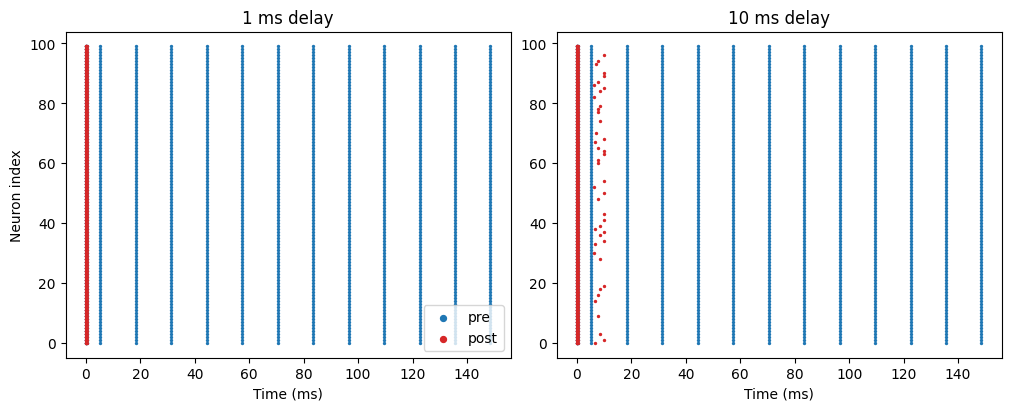
Run the network with a short delay and a long delay and look at when postsynaptic activity appears relative to presynaptic activity.
def run(delay, t_stop=150. * u.ms):
    with brainstate.environ.context(dt=0.1 * u.ms):
        net = DelayedNet(delay)
        brainstate.nn.init_all_states(net)
        times = u.math.arange(0. * u.ms, t_stop, brainstate.environ.get_dt())
        pre_spk, post_spk = brainstate.transform.for_loop(
            lambda t: net.update(t, 30. * u.mA), times)
    return times, pre_spk, post_spk


with brainstate.environ.context(dt=0.1 * u.ms):
    res = {'1 ms delay': run(1. * u.ms), '10 ms delay': run(10. * u.ms)}
fig, gs = braintools.visualize.get_figure(1, 2, 4.0, 5.0)
for k, (title, (times, pre_spk, post_spk)) in enumerate(res.items()):
    ax = fig.add_subplot(gs[0, k])
    ti, ni = u.math.where(pre_spk)
    ax.scatter(times[ti].to_decimal(u.ms), ni, s=2, color='C0', label='pre')
    ti, ni = u.math.where(post_spk)
    ax.scatter(times[ti].to_decimal(u.ms), ni, s=2, color='C3', label='post')
    ax.set_title(title); ax.set_xlabel('Time (ms)')
    if k == 0:
        ax.set_ylabel('Neuron index'); ax.legend(loc='lower right', markerscale=3)
plt.show()
See also#
Tutorial 2 · Synapses and projections — the undelayed baseline.
AlignPre / AlignPost — the keystone — prefetch and projection routing.
How to reproduce a paper: gamma oscillation — delays in a published network.