

Porting walkthrough: Brunel, side by side#
What you’ll learn / who it’s for (porting / simulation). A NEST network ported to brainpy.state, step for step. We take the Brunel (2000) random balanced network with delta synapses and show the NEST (PyNEST) construction next to the brainpy.state Simulator port — with a parameter-mapping table and the semantic divergences a port must account for.
The NEST code blocks below are shown for reference only (they need a live NEST install); the brainpy.state cells are runnable. Source: examples/nest_like/brunel_delta.py and NEST’s brunel_delta_nest.py.
import jax
jax.config.update('jax_enable_x64', True)
import brainstate
brainstate.environ.set(precision=64)

import numpy as np
import brainunit as u
import braintools
import matplotlib.pyplot as plt
from brainpy import state as bp
An NVIDIA GPU may be present on this machine, but a CUDA-enabled jaxlib is not installed. Falling back to cpu.
Step 1 — create populations and devices#
NEST (reference):
import nest
nest.SetKernelStatus({'resolution': 0.1})
nest.SetDefaults('iaf_psc_delta', {
    'C_m': CMem, 'tau_m': tauMem, 't_ref': tref,
    'E_L': 0.0, 'V_reset': 0.0, 'V_th': theta})
nodes_ex = nest.Create('iaf_psc_delta', NE)
nodes_in = nest.Create('iaf_psc_delta', NI)
noise = nest.Create('poisson_generator', params={'rate': p_rate})
espikes = nest.Create('spike_recorder')
ispikes = nest.Create('spike_recorder')
brainpy.state (runnable): there is no global kernel — a Simulator owns the populations, devices, and connections, and parameters carry explicit units.
npar = dict(C_m=CMem * u.pF, tau_m=tauMem * u.ms, t_ref=tref * u.ms,
            E_L=0. * u.mV, V_reset=0. * u.mV, V_th=theta * u.mV,
            V_initializer=braintools.init.Constant(0. * u.mV))

sim = bp.Simulator(dt=0.1 * u.ms)
ne = sim.create(bp.iaf_psc_delta, NE, params=npar)
ni = sim.create(bp.iaf_psc_delta, NI, params=npar)
noise = sim.create(bp.poisson_generator, rate=p_rate * u.Hz)
esr = sim.create(bp.spike_recorder)
isr = sim.create(bp.spike_recorder)
Step 2 — connect#
NEST (reference):
nest.Connect(noise, nodes_ex + nodes_in,
             syn_spec={'weight': J_ex, 'delay': delay})
conn_ex = {'rule': 'fixed_indegree', 'indegree': CE}
conn_in = {'rule': 'fixed_indegree', 'indegree': CI}
nest.Connect(nodes_ex, nodes_ex + nodes_in, conn_ex,
             {'weight': J_ex, 'delay': delay})
nest.Connect(nodes_in, nodes_ex + nodes_in, conn_in,
             {'weight': J_in, 'delay': delay})
nest.Connect(nodes_ex[:N_rec], espikes)
nest.Connect(nodes_in[:N_rec], ispikes)
brainpy.state (runnable): connect(src, dst, weight=, delay=, rule=), with ne + ni population algebra and fixed_indegree(K) — the same shape as nest.Connect. The delta weights are voltages in mV.
sim.connect(noise, ne, weight=J_ex * u.mV, delay=delay * u.ms, rule=bp.all_to_all)
sim.connect(noise, ni, weight=J_ex * u.mV, delay=delay * u.ms, rule=bp.all_to_all)
sim.connect(ne, ne + ni, weight=J_ex * u.mV, delay=delay * u.ms,
            rule=bp.fixed_indegree(CE), comm='sparse', allow_multapses=True, seed=1)
sim.connect(ni, ne + ni, weight=J_in * u.mV, delay=delay * u.ms,
            rule=bp.fixed_indegree(CI), comm='sparse', allow_multapses=True, seed=2)
sim.connect(ne[:N_rec], esr)
sim.connect(ni[:N_rec], isr)
Step 3 — simulate and read back#
NEST (reference): nest.Simulate(1000.0), then nest.GetStatus(espikes, 'n_events') → rate.
brainpy.state (runnable): sim.simulate(T) returns a result; read the rate of a combined-population recorder via esr.segments[0].population.
res = sim.simulate(1000. * u.ms)
erate = res.rate(esr.segments[0].population)
irate = res.rate(isr.segments[0].population)
print(f'excitatory rate: {erate:.2f} spks/s')
print(f'inhibitory rate: {irate:.2f} spks/s')

spk = np.asarray(res.spikes(esr.segments[0].population))
ts, ids = np.nonzero(spk > 0)
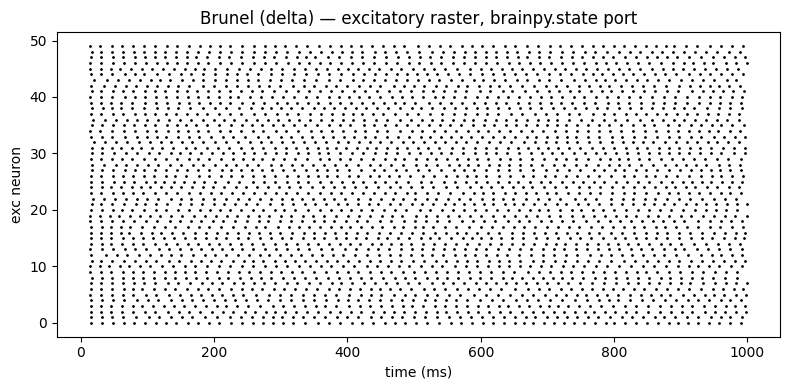
plt.figure(figsize=(8, 4))
plt.scatter(ts * 0.1, ids, s=1.0, color='k')
plt.xlabel('time (ms)'); plt.ylabel('exc neuron')
plt.title('Brunel (delta) — excitatory raster, brainpy.state port')
plt.tight_layout()
excitatory rate: 60.56 spks/s
inhibitory rate: 60.18 spks/s
Parameter mapping#
NEST |
brainpy.state |
Note |
|---|---|---|
|
|
per- |
|
|
returns a |
|
|
units are explicit |
|
|
|
|
|
|
|
|
same draw; |
|
|
delta weight is a voltage ( |
|
|
returns a |
|
|
read from the result |
Divergences this port runs into#
Delta weights are voltages. With
iaf_psc_deltathe postsynaptic amplitude is an instantaneous membrane-voltage jump, so weights aremV(J_ex = J), not thepAcurrents the alpha variant uses.Independent PRNG streams. The Poisson drive and the random
fixed_indegreewiring draw from JAX’s PRNG, which diverges sample-by-sample from NEST’s. Parity for Brunel is therefore distributional — the seed-mean firing rate matches within a 5% band (category D), not spike-by-spike. See validation status.Sparse communication.
comm='sparse'selects the event-driven backend so large fan-in stays memory-light;allow_multapses=Truematches NEST’sfixed_indegreedefault (repeated edges sum).
For the full catalog — where learning state lives, parameter-location maps, the STDP pairing conventions, and the documented numerical bands — see the semantic divergences.
See also#
Connect a network — the same Brunel built from scratch.
Semantic divergences — the full porting catalog.
Validation status — how Brunel parity is asserted (distributional, category D).
Example gallery — full-scale Brunel and other ported networks.