

How to choose between COBA and CUBA synapses#
Task. Decide whether a projection should be conductance-based (COBA) or current-based (CUBA), and switch between them with a one-line change.
Audience. Simulation. Assumes Tutorial 2 · Synapses and projections.
The out= argument of a projection controls how the synaptic variable enters
the postsynaptic neuron:
COBA(E=...)— conductance-based. The synaptic current isg · (E − V): it depends on the postsynaptic voltage and saturates near the reversal potentialE. This is the biophysically faithful choice.CUBA(scale=...)— current-based. The synaptic variable is injected as a current independent ofV. Simpler and often used in analysis and in brain-inspired models.
Everything else about the projection stays the same.
import brainpy
import brainstate
import braintools
import brainunit as u
import matplotlib.pyplot as plt
An NVIDIA GPU may be present on this machine, but a CUDA-enabled jaxlib is not installed. Falling back to cpu.
One network, swappable output#
We parametrize the E/I network by the output describer so we can build a COBA version and a CUBA version from the same class. (This is the Vogels–Abbott balanced network; the COBA form is Tutorial 3.)
class EINet(brainstate.nn.Module):
    def __init__(self, exc_out, inh_out, exc_w, inh_w):
        super().__init__()
        self.n_exc, self.n_inh = 3200, 800
        self.num = self.n_exc + self.n_inh
        self.N = brainpy.state.LIFRef(
            self.num, V_rest=-60. * u.mV, V_th=-50. * u.mV, V_reset=-60. * u.mV,
            tau=20. * u.ms, tau_ref=5. * u.ms,
            V_initializer=braintools.init.Normal(-55., 2., unit=u.mV))
        self.E = brainpy.state.AlignPostProj(
            comm=brainstate.nn.EventFixedProb(
                self.n_exc, self.num, conn_num=0.02, conn_weight=exc_w),
            syn=brainpy.state.Expon.desc(self.num, tau=5. * u.ms),
            out=exc_out, post=self.N)
        self.I = brainpy.state.AlignPostProj(
            comm=brainstate.nn.EventFixedProb(
                self.n_inh, self.num, conn_num=0.02, conn_weight=inh_w),
            syn=brainpy.state.Expon.desc(self.num, tau=10. * u.ms),
            out=inh_out, post=self.N)

    def update(self, t, inp):
        with brainstate.environ.context(t=t):
            spk = self.N.get_spike() != 0.
            self.E(spk[:self.n_exc]); self.I(spk[self.n_exc:]); self.N(inp)
            return self.N.get_spike()


def simulate(net, t_stop=500. * u.ms):
    brainstate.nn.init_all_states(net)
    with brainstate.environ.context(dt=0.1 * u.ms):
        times = u.math.arange(0. * u.ms, t_stop, brainstate.environ.get_dt())
        spikes = brainstate.transform.for_loop(
            lambda t: net.update(t, 20. * u.mA), times)
    return times, spikes
Conductance-based (COBA)#
Excitation reverses at 0 mV, inhibition at −80 mV; weights are conductances in millisiemens.
with brainstate.environ.context(dt=0.1 * u.ms):
    coba = EINet(
        exc_out=brainpy.state.COBA.desc(E=0. * u.mV),
        inh_out=brainpy.state.COBA.desc(E=-80. * u.mV),
        exc_w=0.6 * u.mS, inh_w=6.7 * u.mS)
times_coba, spk_coba = simulate(coba)
Current-based (CUBA)#
Same wiring, but out=CUBA(scale=...) injects a current directly; inhibitory
weights are simply negative. No reversal potential is involved.
with brainstate.environ.context(dt=0.1 * u.ms):
    cuba = EINet(
        exc_out=brainpy.state.CUBA.desc(scale=u.volt),
        inh_out=brainpy.state.CUBA.desc(scale=u.volt),
        exc_w=1.62 * u.mS, inh_w=-9.0 * u.mS)
times_cuba, spk_cuba = simulate(cuba)
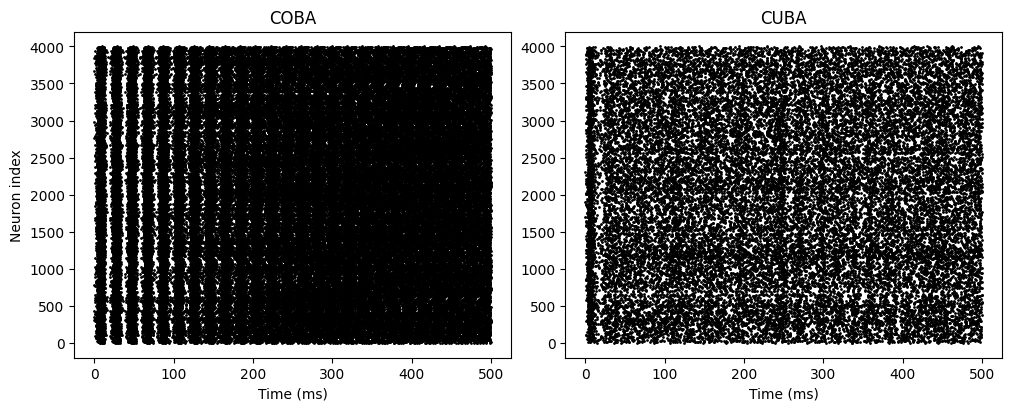
Compare the rasters#
fig, gs = braintools.visualize.get_figure(1, 2, 4.0, 5.0)
for k, (title, times, spk) in enumerate(
        [('COBA', times_coba, spk_coba), ('CUBA', times_cuba, spk_cuba)]):
    ax = fig.add_subplot(gs[0, k])
    ti, ni = u.math.where(spk)
    ax.scatter(times[ti].to_decimal(u.ms), ni, s=1, color='k')
    ax.set_title(title); ax.set_xlabel('Time (ms)')
    if k == 0:
        ax.set_ylabel('Neuron index')
plt.show()
See also#
AlignPre / AlignPost — the keystone — why the synaptic state is exponential and aligned to the postsynaptic side.
BrainPy-style Synaptic Outputs —
COBA,CUBA, andMgBlockreference.How to add short-term plasticity — make synapses dynamic.