

Tutorial 3: Getting Started with optax Optimizers#
Difficulty: Beginner
Duration: 20-30 minutes
Prerequisites: Basic knowledge of JAX and neural networks
Learning Objectives#
Understand the optimizer interface in braintools
Use basic optimizers (SGD, Adam, AdamW)
Train a simple neural network
Compare different optimizer behaviors
Topics Covered#
Setting up a simple model
Creating a basic feedforward network with brainstate
Defining a loss function
Using basic optimizers
SGD with momentum
Adam optimizer
AdamW with weight decay
Training loop implementation
Gradient computation
Parameter updates
Loss tracking
Comparing optimizer performance
Convergence speed comparison
Loss landscape visualization
Hyperparameter sensitivity
import time

import brainstate
import jax
import jax.numpy as jnp
import matplotlib.pyplot as plt
import numpy as np

import braintools
1. Setting up a Simple Model#
Let’s start by creating a basic feedforward network using brainstate. This will be our test model for comparing different optimizers.
class FeedForwardNet(brainstate.nn.Module):
    """Simple feedforward network for classification."""

    def __init__(self, input_dim=784, hidden_dims=(128, 64), output_dim=10):
        super().__init__()

        # Build layers
        self.layers = []
        prev_dim = input_dim

        for hidden_dim in hidden_dims:
            self.layers.append(brainstate.nn.Linear(prev_dim, hidden_dim))
            prev_dim = hidden_dim

        # Output layer
        self.output_layer = brainstate.nn.Linear(prev_dim, output_dim)

    def __call__(self, x):
        # Forward pass through hidden layers
        for layer in self.layers:
            x = layer(x)
            x = jax.nn.relu(x)

        # Output layer (no activation for logits)
        x = self.output_layer(x)
        return x
2. Preparing MNIST Data#
Let’s create a simple MNIST-like dataset for our experiments.
def create_synthetic_mnist_data(n_samples=1000, seed=42):
    """Create synthetic MNIST-like data for demonstration."""

    with brainstate.random.seed_context(seed):
        # Create random input data (28x28 images flattened)
        X = brainstate.random.normal(size=(n_samples, 784)) * 0.5

        # Create random labels (10 classes)
        y = brainstate.random.randint(0, 10, size=(n_samples,))
        return X, y


# Generate training and validation data
X_train, y_train = create_synthetic_mnist_data(n_samples=5000, seed=42)
X_val, y_val = create_synthetic_mnist_data(n_samples=1000, seed=43)

print(f"Training data shape: {X_train.shape}")
print(f"Training labels shape: {y_train.shape}")
print(f"Validation data shape: {X_val.shape}")
print(f"Validation labels shape: {y_val.shape}")
Training data shape: (5000, 784)
Training labels shape: (5000,)
Validation data shape: (1000, 784)
Validation labels shape: (1000,)
3. Defining Loss Function and Gradient Computation#
Following the style from grad_computation.py, we’ll define our loss function and gradient computation.
def compute_loss_and_grads(model, X, y, param_states):
    """Compute loss and gradients following braintools style.

    Args:
        model: The neural network model
        X: Input data
        y: Target labels
        param_states: Dictionary of parameter states

    Returns:
        loss: Scalar loss value
        grads: Gradients with respect to parameters
        accuracy: Classification accuracy
    """

    def loss_fn():
        # Forward pass
        logits = model(X)

        # Compute cross-entropy loss
        log_probs = jax.nn.log_softmax(logits, axis=-1)
        one_hot = jax.nn.one_hot(y, num_classes=10)
        loss = -jnp.mean(jnp.sum(one_hot * log_probs, axis=-1))

        return loss

    # Compute loss
    loss = loss_fn()

    # Compute gradients with respect to parameters
    grads = brainstate.transform.grad(loss_fn, grad_states=param_states)()

    # Compute accuracy for monitoring
    logits = model(X)
    predictions = jnp.argmax(logits, axis=-1)
    accuracy = jnp.mean(predictions == y)

    return loss, grads, accuracy
4. Training with Basic Optimizers#
Now let’s implement training loops for different optimizers: SGD, Adam, and AdamW.
def train_model(
    model: brainstate.nn.Module,
    optimizer: braintools.optim.OptaxOptimizer,
    n_epochs=50,
    batch_size=128,
    verbose=True
):
    # Get parameter states for gradient computation
    param_states = braintools.optim.UniqueStateManager(
        model.states(brainstate.ParamState)
    ).to_pytree()

    # Initialize optimizer state
    optimizer.register_trainable_weights(param_states)

    @brainstate.transform.jit
    def train_step(X_batch, y_batch):
        loss, grads, acc = compute_loss_and_grads(model, X_batch, y_batch, param_states)
        optimizer.update(grads)
        return loss, acc

    @brainstate.transform.jit
    def eval_step(X_batch, y_batch):
        loss, _, acc = compute_loss_and_grads(model, X_batch, y_batch, param_states)
        return loss, acc

    # Training history
    history = {
        'train_loss': [],
        'train_acc': [],
        'val_loss': [],
        'val_acc': [],
        'epoch_time': []
    }

    n_batches = len(X_train) // batch_size

    for epoch in range(n_epochs):
        epoch_start = time.time()

        # Shuffle training data
        perm = brainstate.random.permutation(len(X_train))
        X_train_shuffled = X_train[perm]
        y_train_shuffled = y_train[perm]

        # Training metrics
        train_losses = []
        train_accs = []

        for batch_idx in range(n_batches):
            # Get batch
            start_idx = batch_idx * batch_size
            end_idx = start_idx + batch_size
            X_batch = X_train_shuffled[start_idx:end_idx]
            y_batch = y_train_shuffled[start_idx:end_idx]

            # Compute loss and gradients
            loss, acc = train_step(X_batch, y_batch)

            train_losses.append(float(loss))
            train_accs.append(float(acc))

        # Validation
        val_loss, val_acc = eval_step(X_val, y_val)
        optimizer.lr.step()  # Update learning rate if using a scheduler

        # Record metrics
        epoch_time = time.time() - epoch_start
        history['train_loss'].append(np.mean(train_losses))
        history['train_acc'].append(np.mean(train_accs))
        history['val_loss'].append(float(val_loss))
        history['val_acc'].append(float(val_acc))
        history['epoch_time'].append(epoch_time)

        if verbose and (epoch + 1) % 10 == 0:
            print(f"Epoch {epoch + 1}/{n_epochs} - "
                  f"Train Loss: {history['train_loss'][-1]:.4f}, "
                  f"Train Acc: {history['train_acc'][-1]:.4f}, "
                  f"Val Loss: {history['val_loss'][-1]:.4f}, "
                  f"Val Acc: {history['val_acc'][-1]:.4f}, "
                  f"Time: {epoch_time:.2f}s")

    return history
4.1 Training with SGD#
# Initialize model for SGD
model_sgd = FeedForwardNet()

# Create SGD optimizer with momentum
sgd_optimizer = braintools.optim.SGD(
    lr=braintools.optim.ExponentialLR(0.1, gamma=0.95),
    momentum=0.9
)

# Train with SGD
print("Training with SGD (with momentum)...")
history_sgd = train_model(model_sgd, sgd_optimizer, n_epochs=50, batch_size=128)
Training with SGD (with momentum)...
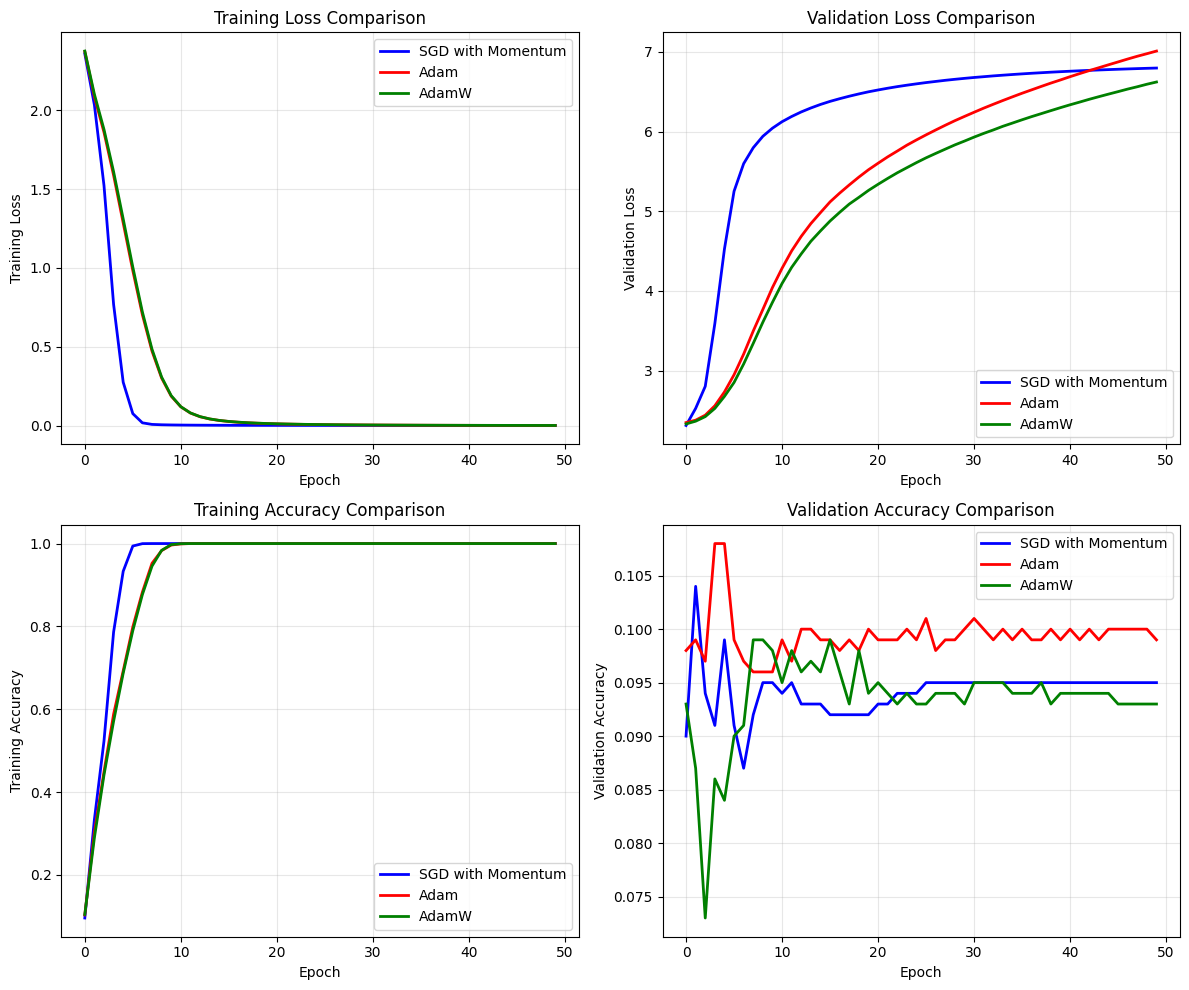
Epoch 10/50 - Train Loss: 0.0047, Train Acc: 1.0000, Val Loss: 6.0427, Val Acc: 0.0950, Time: 0.10s
Epoch 20/50 - Train Loss: 0.0020, Train Acc: 1.0000, Val Loss: 6.4993, Val Acc: 0.0920, Time: 0.10s
Epoch 30/50 - Train Loss: 0.0015, Train Acc: 1.0000, Val Loss: 6.6681, Val Acc: 0.0950, Time: 0.10s
Epoch 40/50 - Train Loss: 0.0013, Train Acc: 1.0000, Val Loss: 6.7519, Val Acc: 0.0950, Time: 0.09s
Epoch 50/50 - Train Loss: 0.0012, Train Acc: 1.0000, Val Loss: 6.7976, Val Acc: 0.0950, Time: 0.09s
4.2 Training with Adam#
# Initialize model for Adam
model_adam = FeedForwardNet()

# Create Adam optimizer
adam_optimizer = braintools.optim.Adam(
    lr=0.001,
    betas=(0.9, 0.999),
    eps=1e-8
)

# Train with Adam
print("Training with Adam...")
history_adam = train_model(model_adam, adam_optimizer, n_epochs=50, batch_size=128)
Training with Adam...
Epoch 10/50 - Train Loss: 0.1872, Train Acc: 0.9964, Val Loss: 4.0425, Val Acc: 0.0960, Time: 0.10s
Epoch 20/50 - Train Loss: 0.0134, Train Acc: 1.0000, Val Loss: 5.5207, Val Acc: 0.1000, Time: 0.08s
Epoch 30/50 - Train Loss: 0.0045, Train Acc: 1.0000, Val Loss: 6.1902, Val Acc: 0.1000, Time: 0.09s
Epoch 40/50 - Train Loss: 0.0022, Train Acc: 1.0000, Val Loss: 6.6483, Val Acc: 0.0990, Time: 0.10s
Epoch 50/50 - Train Loss: 0.0013, Train Acc: 1.0000, Val Loss: 7.0110, Val Acc: 0.0990, Time: 0.09s
4.3 Training with AdamW#
# Initialize model for AdamW
model_adamw = FeedForwardNet()

# Create AdamW optimizer with weight decay
adamw_optimizer = braintools.optim.AdamW(
    lr=0.001,
    betas=(0.9, 0.999),
    eps=1e-8,
    weight_decay=0.01
)

# Train with AdamW
print("Training with AdamW (with weight decay)...")
history_adamw = train_model(model_adamw, adamw_optimizer, n_epochs=50, batch_size=128)
Training with AdamW (with weight decay)...
Epoch 10/50 - Train Loss: 0.1904, Train Acc: 0.9974, Val Loss: 3.8565, Val Acc: 0.0980, Time: 0.11s
Epoch 20/50 - Train Loss: 0.0138, Train Acc: 1.0000, Val Loss: 5.2613, Val Acc: 0.0940, Time: 0.10s
Epoch 30/50 - Train Loss: 0.0048, Train Acc: 1.0000, Val Loss: 5.8808, Val Acc: 0.0930, Time: 0.09s
Epoch 40/50 - Train Loss: 0.0024, Train Acc: 1.0000, Val Loss: 6.3004, Val Acc: 0.0940, Time: 0.11s
Epoch 50/50 - Train Loss: 0.0014, Train Acc: 1.0000, Val Loss: 6.6224, Val Acc: 0.0930, Time: 0.10s
5. Comparing Optimizer Performance#
Let’s visualize and compare the performance of different optimizers.
def plot_optimizer_comparison(histories, names):
    """Plot comparison of different optimizers."""
    fig, axes = plt.subplots(2, 2, figsize=(12, 10))

    colors = ['blue', 'red', 'green', 'orange', 'purple']

    # Training loss
    ax = axes[0, 0]
    for i, (history, name) in enumerate(zip(histories, names)):
        ax.plot(history['train_loss'], label=name, color=colors[i], linewidth=2)
    ax.set_xlabel('Epoch')
    ax.set_ylabel('Training Loss')
    ax.set_title('Training Loss Comparison')
    ax.legend()
    ax.grid(True, alpha=0.3)

    # Validation loss
    ax = axes[0, 1]
    for i, (history, name) in enumerate(zip(histories, names)):
        ax.plot(history['val_loss'], label=name, color=colors[i], linewidth=2)
    ax.set_xlabel('Epoch')
    ax.set_ylabel('Validation Loss')
    ax.set_title('Validation Loss Comparison')
    ax.legend()
    ax.grid(True, alpha=0.3)

    # Training accuracy
    ax = axes[1, 0]
    for i, (history, name) in enumerate(zip(histories, names)):
        ax.plot(history['train_acc'], label=name, color=colors[i], linewidth=2)
    ax.set_xlabel('Epoch')
    ax.set_ylabel('Training Accuracy')
    ax.set_title('Training Accuracy Comparison')
    ax.legend()
    ax.grid(True, alpha=0.3)

    # Validation accuracy
    ax = axes[1, 1]
    for i, (history, name) in enumerate(zip(histories, names)):
        ax.plot(history['val_acc'], label=name, color=colors[i], linewidth=2)
    ax.set_xlabel('Epoch')
    ax.set_ylabel('Validation Accuracy')
    ax.set_title('Validation Accuracy Comparison')
    ax.legend()
    ax.grid(True, alpha=0.3)

    plt.tight_layout()
    plt.show()


# Compare optimizers
histories = [history_sgd, history_adam, history_adamw]
names = ['SGD with Momentum', 'Adam', 'AdamW']
plot_optimizer_comparison(histories, names)
6. Visualizing Optimization Paths in 2D Loss Landscape#
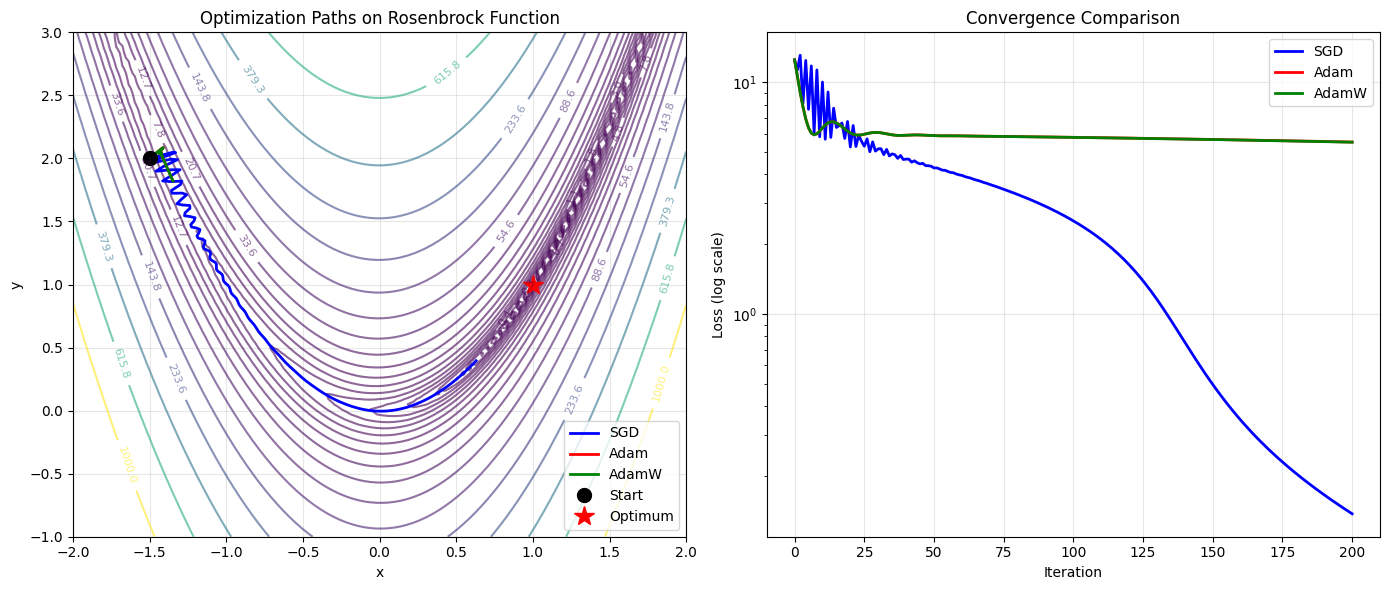
Let’s create a simple 2D optimization problem to visualize how different optimizers navigate the loss landscape.
def rosenbrock(x, y):
    """Rosenbrock function for 2D optimization visualization."""
    return (1 - x) ** 2 + 100 * (y - x ** 2) ** 2


def optimize_2d_function(
    optimizer_fn: braintools.optim.OptaxOptimizer,
    n_steps=100,
    init_point=(-1.5, 2.0),
):
    """Optimize a 2D function and track the path."""

    # Initialize parameters
    params = {
        'x': brainstate.ParamState(jnp.array(init_point[0])),
        'y': brainstate.ParamState(jnp.array(init_point[1])),
    }

    # Initialize optimizer
    optimizer_fn.register_trainable_weights(params)

    # Track optimization path
    path = [(float(params['x'].value), float(params['y'].value))]
    losses = [float(rosenbrock(params['x'].value, params['y'].value))]

    for step in range(n_steps):
        # Compute gradients
        def loss_fn():
            return rosenbrock(params['x'].value, params['y'].value)

        grads = brainstate.transform.grad(loss_fn, grad_states=params)()

        # Update parameters
        optimizer_fn.update(grads)

        # Track path
        path.append((float(params['x'].value), float(params['y'].value)))
        losses.append(float(rosenbrock(params['x'].value, params['y'].value)))

    return np.array(path), np.array(losses)


# Optimize with different methods
path_sgd, losses_sgd = optimize_2d_function(braintools.optim.SGD(lr=0.001, momentum=0.9), n_steps=200)
path_adam, losses_adam = optimize_2d_function(braintools.optim.Adam(lr=0.01), n_steps=200)
path_adamw, losses_adamw = optimize_2d_function(braintools.optim.AdamW(lr=0.01, weight_decay=0.001), n_steps=200)
# Visualize optimization paths
fig, axes = plt.subplots(1, 2, figsize=(14, 6))

# Create contour plot
x = np.linspace(-2, 2, 100)
y = np.linspace(-1, 3, 100)
X, Y = np.meshgrid(x, y)
Z = rosenbrock(X, Y)

# Plot optimization paths
ax = axes[0]
contour = ax.contour(X, Y, Z, levels=np.logspace(-1, 3, 20), cmap='viridis', alpha=0.6)
ax.clabel(contour, inline=True, fontsize=8)

# Plot paths
ax.plot(path_sgd[:, 0], path_sgd[:, 1], 'b-', label='SGD', linewidth=2)
ax.plot(path_adam[:, 0], path_adam[:, 1], 'r-', label='Adam', linewidth=2)
ax.plot(path_adamw[:, 0], path_adamw[:, 1], 'g-', label='AdamW', linewidth=2)

# Mark start and end points
ax.plot(path_sgd[0, 0], path_sgd[0, 1], 'ko', markersize=10, label='Start')
ax.plot(1, 1, 'r*', markersize=15, label='Optimum')

ax.set_xlabel('x')
ax.set_ylabel('y')
ax.set_title('Optimization Paths on Rosenbrock Function')
ax.legend()
ax.grid(True, alpha=0.3)

# Plot convergence curves
ax = axes[1]
ax.semilogy(losses_sgd, 'b-', label='SGD', linewidth=2)
ax.semilogy(losses_adam, 'r-', label='Adam', linewidth=2)
ax.semilogy(losses_adamw, 'g-', label='AdamW', linewidth=2)

ax.set_xlabel('Iteration')
ax.set_ylabel('Loss (log scale)')
ax.set_title('Convergence Comparison')
ax.legend()
ax.grid(True, alpha=0.3)

plt.tight_layout()
plt.show()
7. Hyperparameter Sensitivity Analysis#
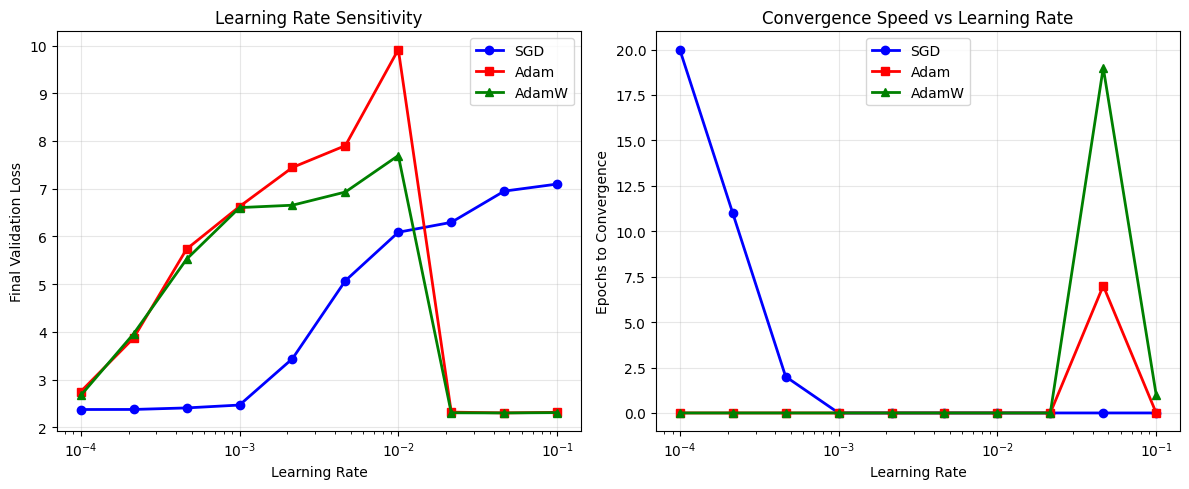
Let’s analyze how sensitive different optimizers are to learning rate changes.
def test_learning_rates(optimizer_class, learning_rates, optimizer_kwargs={}):
    """Test optimizer with different learning rates."""
    final_losses = []
    convergence_speeds = []

    for lr in learning_rates:
        # Create model
        model = FeedForwardNet()

        # Create optimizer with specific learning rate
        optimizer = optimizer_class(lr=lr, **optimizer_kwargs)

        # Train model
        history = train_model(model, optimizer, n_epochs=30, batch_size=64, verbose=False)

        # Record metrics
        final_losses.append(history['val_loss'][-1])

        # Calculate convergence speed (epochs to reach 90% of final performance)
        target_loss = history['val_loss'][0] * 0.1 + history['val_loss'][-1] * 0.9
        for epoch, loss in enumerate(history['val_loss']):
            if loss <= target_loss:
                convergence_speeds.append(epoch)
                break
        else:
            convergence_speeds.append(30)  # Max epochs if not converged

    return final_losses, convergence_speeds


# Test learning rates
learning_rates = np.logspace(-4, -1, 10)

print("Testing SGD with different learning rates...")
sgd_losses, sgd_speeds = test_learning_rates(
    braintools.optim.SGD, learning_rates, {'momentum': 0.9}
)

print("Testing Adam with different learning rates...")
adam_losses, adam_speeds = test_learning_rates(
    braintools.optim.Adam, learning_rates
)

print("Testing AdamW with different learning rates...")
adamw_losses, adamw_speeds = test_learning_rates(
    braintools.optim.AdamW, learning_rates, {'weight_decay': 0.01}
)
Testing SGD with different learning rates...
Testing Adam with different learning rates...
Testing AdamW with different learning rates...
# Plot hyperparameter sensitivity
fig, axes = plt.subplots(1, 2, figsize=(12, 5))

# Final loss vs learning rate
ax = axes[0]
ax.semilogx(learning_rates, sgd_losses, 'b-o', label='SGD', linewidth=2)
ax.semilogx(learning_rates, adam_losses, 'r-s', label='Adam', linewidth=2)
ax.semilogx(learning_rates, adamw_losses, 'g-^', label='AdamW', linewidth=2)

ax.set_xlabel('Learning Rate')
ax.set_ylabel('Final Validation Loss')
ax.set_title('Learning Rate Sensitivity')
ax.legend()
ax.grid(True, alpha=0.3)

# Convergence speed vs learning rate
ax = axes[1]
ax.semilogx(learning_rates, sgd_speeds, 'b-o', label='SGD', linewidth=2)
ax.semilogx(learning_rates, adam_speeds, 'r-s', label='Adam', linewidth=2)
ax.semilogx(learning_rates, adamw_speeds, 'g-^', label='AdamW', linewidth=2)

ax.set_xlabel('Learning Rate')
ax.set_ylabel('Epochs to Convergence')
ax.set_title('Convergence Speed vs Learning Rate')
ax.legend()
ax.grid(True, alpha=0.3)

plt.tight_layout()
plt.show()
Summary and Key Takeaways#
In this tutorial, we’ve explored the basic optimizers available in braintools:
SGD with Momentum
Simple and reliable
Requires careful learning rate tuning
Good for convex problems
Momentum helps escape local minima
Adam
Adaptive learning rates per parameter
Fast convergence
Less sensitive to learning rate choice
Good default choice for many problems
AdamW
Decoupled weight decay regularization
Better generalization than Adam
Particularly effective for transformer models
Helps prevent overfitting
Exercises#
Learning Rate Scheduling: Implement a training loop that uses different learning rate schedules (step decay, cosine annealing) and compare their effects.
Custom Loss Function: Create a custom loss function with L1/L2 regularization and observe how it affects different optimizers.
Batch Size Effects: Investigate how batch size affects the performance of different optimizers.
Gradient Clipping: Add gradient clipping to the training loop and analyze its impact on training stability.
Optimizer Combinations: Try using different optimizers for different parts of the network (e.g., different learning rates for different layers).