

Perceptual Decision-Making with Wong-Wang#
The Wong-Wang model (Wong & Wang, 2006) is the canonical reduced circuit for a two-choice
perceptual decision. Two populations of neurons — one for each choice — compete through
recurrent self-excitation and mutual inhibition. The competition makes the circuit bistable:
from a symmetric resting state it commits to one of two high-activity attractors. A sensory
evidence signal (motion coherence) biases which attractor wins, and the slow ramp of the
synaptic gating variables S1/S2 is the model’s signature of evidence accumulation.
This case study demonstrates:
evidence accumulation — the gating variables ramping to a decision under noise,
bistability — symmetric (zero-evidence) trials breaking left or right at random, and
a psychometric sweep — choice probability vs. evidence strength.
Reference: Wong & Wang (2006), A recurrent network mechanism of time integration in
perceptual decisions, J. Neurosci. 26(4):1314-1328. The model is bundled as
WongWangStep — no external data needed.
Note
WongWangStep is the reduced two-variable decision model (states S1,
S2; update(coherence=...)), distinct from WongWangExcInhStep, the
excitatory/inhibitory mean-field model used for resting-state BOLD.
1. A single decision trial#
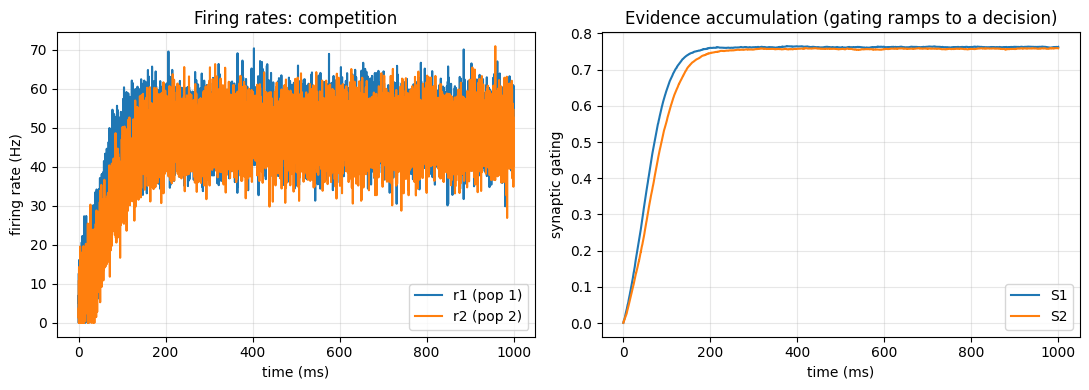
We drive the circuit with a constant rightward coherence (favoring population 1) and inject
small current noise into each population so trials are stochastic. The firing rates r1, r2
start together, then one wins. The whole trial is compiled into a single
brainstate.transform.for_loop() — the brainmass idiom for running a model many steps — so
each trial is fast and we can run dozens of them below.
dt = 0.1 * u.ms

def run_trial(coherence, *, duration=1000.0 * u.ms, sigma=0.02 * u.nA, seed=0):
    """Run one Wong-Wang decision trial; return time, rates (r1, r2), gating (S1, S2)."""
    brainstate.random.seed(seed)
    model = brainmass.WongWangStep(
        in_size=1,
        noise_s1=brainmass.GaussianNoise(1, sigma=sigma),
        noise_s2=brainmass.GaussianNoise(1, sigma=sigma),
    )
    brainstate.nn.init_all_states(model)
    n_steps = int(duration / dt)

    def step(i):
        r1, r2 = model.update(coherence=coherence)
        return (u.get_magnitude(r1[0]), u.get_magnitude(r2[0]),
                model.S1.value[0], model.S2.value[0])

    with brainstate.environ.context(dt=dt):
        r1s, r2s, s1s, s2s = brainstate.transform.for_loop(step, np.arange(n_steps))
    ts = (np.arange(n_steps) + 1) * u.get_magnitude(dt)
    return ts, np.asarray(r1s), np.asarray(r2s), np.asarray(s1s), np.asarray(s2s)

ts, r1, r2, s1, s2 = run_trial(coherence=0.25, seed=1)
winner = 1 if s1[-1] > s2[-1] else 2
print(f"coherence = +0.25 (favors pop 1)  ->  winner: population {winner}")
print(f"final gating: S1 = {s1[-1]:.3f}, S2 = {s2[-1]:.3f}")
coherence = +0.25 (favors pop 1)  ->  winner: population 1
final gating: S1 = 0.763, S2 = 0.759
fig, (ax1, ax2) = plt.subplots(1, 2, figsize=(11, 4))
ax1.plot(ts, r1, label='r1 (pop 1)'); ax1.plot(ts, r2, label='r2 (pop 2)')
ax1.set_xlabel('time (ms)'); ax1.set_ylabel('firing rate (Hz)')
ax1.set_title('Firing rates: competition'); ax1.legend(); ax1.grid(alpha=0.3)
ax2.plot(ts, s1, label='S1'); ax2.plot(ts, s2, label='S2')
ax2.set_xlabel('time (ms)'); ax2.set_ylabel('synaptic gating')
ax2.set_title('Evidence accumulation (gating ramps to a decision)')
ax2.legend(); ax2.grid(alpha=0.3)
plt.tight_layout()
plt.show()
2. Bistability under zero evidence#
With no evidence (coherence = 0) the circuit is symmetric, but noise still pushes it into
one of the two attractors — and which one varies trial to trial. Running several zero-coherence
trials with different noise seeds shows the spontaneous left/right split that is the hallmark of
a bistable decision circuit.
fig, ax = plt.subplots(figsize=(9, 4))
n_trials = 8
choices = []
for seed in range(n_trials):
    t, _, _, s1_t, s2_t = run_trial(coherence=0.0, seed=seed)
    choice = 1 if s1_t[-1] > s2_t[-1] else 2
    choices.append(choice)
    color = 'tab:blue' if choice == 1 else 'tab:red'
    ax.plot(t, s1_t - s2_t, color=color, alpha=0.7)
ax.axhline(0, color='grey', lw=1)
ax.set_xlabel('time (ms)'); ax.set_ylabel('S1 - S2  (decision variable)')
ax.set_title(f'Zero-evidence bistability: {choices.count(1)} chose pop 1, '
             f'{choices.count(2)} chose pop 2')
plt.tight_layout()
plt.show()
print("per-trial choices (zero coherence):", choices)
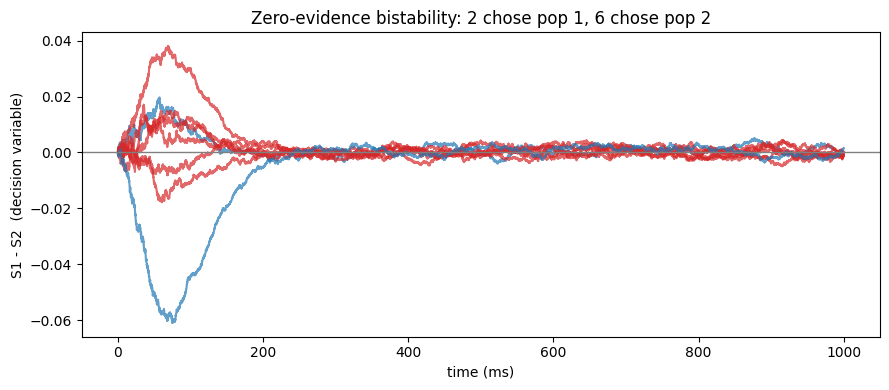
per-trial choices (zero coherence): [1, 2, 2, 2, 2, 2, 2, 1]
3. Psychometric curve#
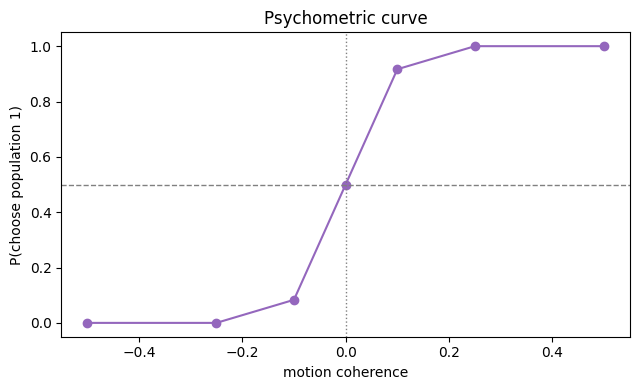
Sweeping the evidence strength and measuring how often population 1 wins traces a psychometric curve: chance (50%) at zero coherence, rising toward certainty as the evidence grows. We average several noisy trials per coherence level.
coherences = [-0.5, -0.25, -0.1, 0.0, 0.1, 0.25, 0.5]
n_rep = 12
p_choose_1 = []
for c in coherences:
    wins = 0
    for seed in range(n_rep):
        _, _, _, s1_t, s2_t = run_trial(coherence=c, seed=seed, duration=800.0 * u.ms)
        wins += int(s1_t[-1] > s2_t[-1])
    p_choose_1.append(wins / n_rep)
    print(f"coherence = {c:+.2f}  ->  P(choose pop 1) = {wins / n_rep:.2f}")

fig, ax = plt.subplots(figsize=(6.5, 4))
ax.plot(coherences, p_choose_1, 'o-', color='tab:purple')
ax.axhline(0.5, color='grey', ls='--', lw=1)
ax.axvline(0.0, color='grey', ls=':', lw=1)
ax.set_xlabel('motion coherence'); ax.set_ylabel('P(choose population 1)')
ax.set_ylim(-0.05, 1.05); ax.set_title('Psychometric curve')
plt.tight_layout()
plt.show()
coherence = -0.50 -> P(choose pop 1) = 0.00
coherence = -0.25 -> P(choose pop 1) = 0.00
coherence = -0.10 -> P(choose pop 1) = 0.08
coherence = +0.00 -> P(choose pop 1) = 0.50
coherence = +0.10 -> P(choose pop 1) = 0.92
coherence = +0.25 -> P(choose pop 1) = 1.00
coherence = +0.50 -> P(choose pop 1) = 1.00
Summary#
The Wong-Wang circuit reproduces the core phenomena of two-choice perceptual decisions:
evidence accumulation — the synaptic gating variables
S1/S2ramp up and one wins,bistability — under zero evidence, noise alone breaks the symmetry left or right, and
a psychometric curve — choice probability rises smoothly with evidence strength.
WongWangStep exposes the rates via update(coherence=...) and the gating
state via model.S1 / model.S2. A constant scalar drive like coherence is passed directly to
update; the noise injected through noise_s1/noise_s2 is what makes individual trials
stochastic. This single-circuit model is the decision-making node you would embed in a larger
network to study distributed choice.