

Seizure Dynamics with the Epileptor#
The Epileptor (Jirsa et al., 2014) is the reference whole-brain model of epileptic seizures.
It is a six-dimensional system that couples a fast oscillatory subsystem, a slower
spike-and-wave subsystem, and — crucially — a slow permittivity variable z that evolves on
a much longer timescale. That slow variable autonomously ramps seizure-like discharges on and
then off, reproducing the stereotyped onset / offset structure of a focal seizure without
any external trigger.
This case study shows:
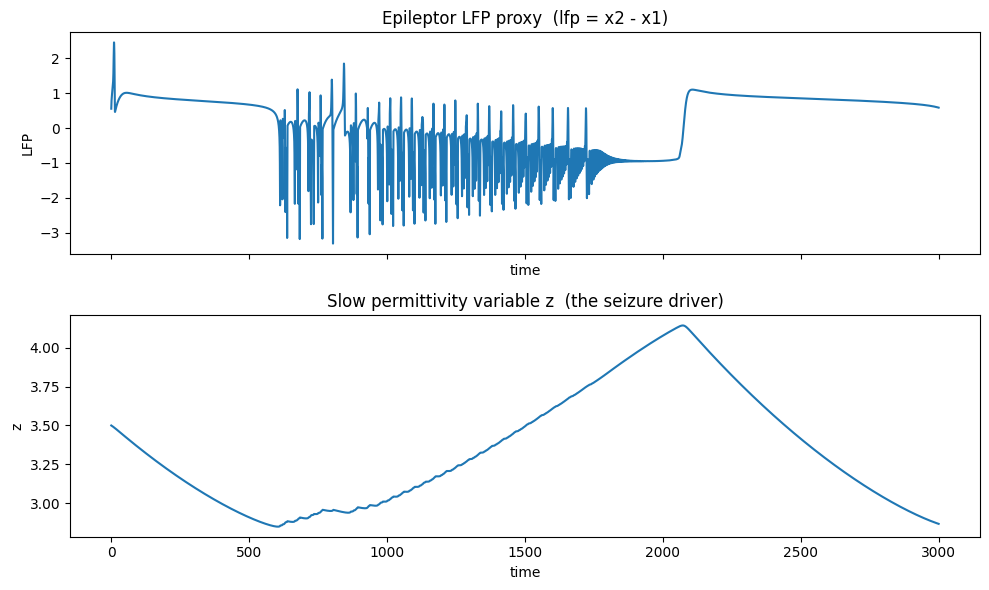
an epileptogenic node generating a full seizure cycle, with the LFP proxy
lfp = x2 − x1and the hidden slow driverzplotted together,how the epileptogenicity parameter
x0separates healthy tissue from a seizure focus, andthe bifurcation it controls.
Reference: Jirsa, Stacey, Quilichini, Ivanov & Bernard (2014), On the nature of seizure
dynamics, Brain 137(8):2210-2230. The model is fully bundled in
EpileptorStep — no external data is needed.
1. An epileptogenic node#
x0 sets the node’s excitability (epileptogenicity). x0 = -1.6 puts the node firmly in the
seizing regime, so it will discharge autonomously. The slow z is stiff, so we need a long
run (here 3 s at dt = 0.1 ms) for a complete onset → ictal → offset cycle to play out.
node = brainmass.EpileptorStep(in_size=1, x0=-1.6)
sim = brainmass.Simulator(node, dt=0.1 * u.ms)
res = sim.run(
    3000.0 * u.ms,
    monitors={'lfp': lambda m: m.lfp(), 'z': 'z', 'x1': 'x1'},
)
print("recorded steps:", res['lfp'].shape[0])
lfp_mag = u.get_magnitude(res['lfp'])
print(f"LFP range: [{lfp_mag.min():.2f}, {lfp_mag.max():.2f}]  (large excursions = ictal)")
recorded steps: 30000
LFP range: [-3.31, 2.45]  (large excursions = ictal)
3. Epileptogenicity: healthy vs. seizure focus#
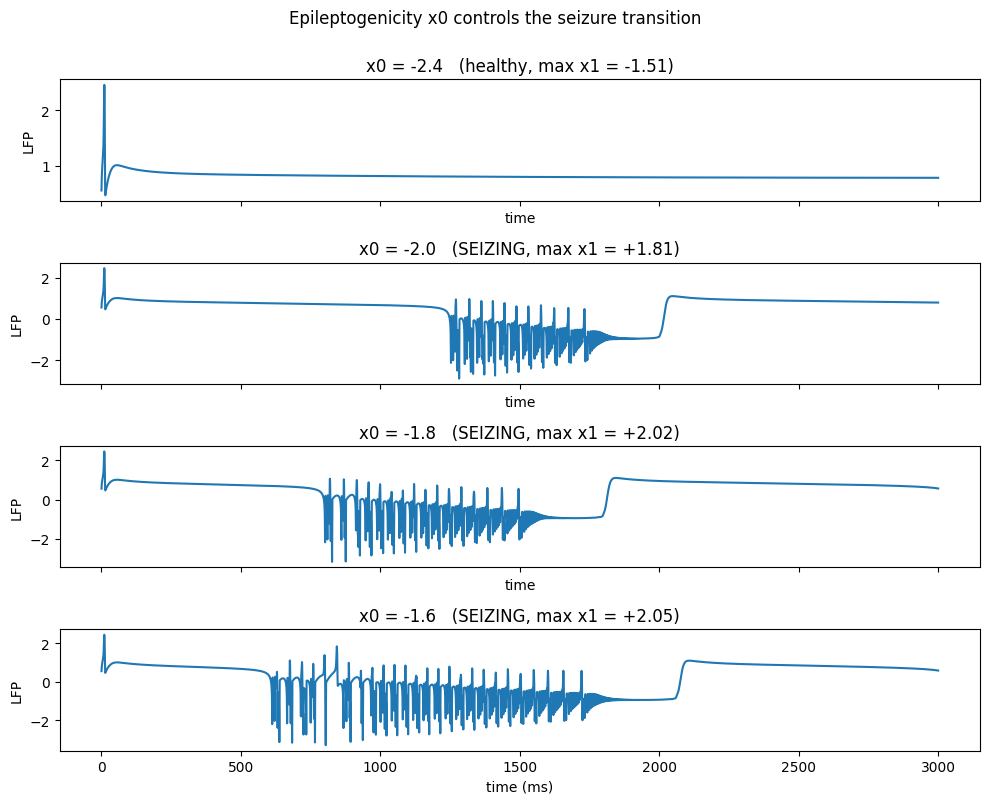
The same node is healthy or a seizure focus depending only on x0. We sweep it across
the boundary (near x0 ≈ -2.0) and use the peak of the fast variable x1 as a simple seizure
indicator: a healthy node keeps x1 negative, a seizing node drives it positive.
records = {}
for x0 in [-2.4, -2.0, -1.8, -1.6]:
    m = brainmass.EpileptorStep(in_size=1, x0=x0)
    r = brainmass.Simulator(m, dt=0.1 * u.ms).run(
        3000.0 * u.ms, monitors={'lfp': lambda mm: mm.lfp(), 'x1': 'x1'})
    x1max = float(np.max(u.get_magnitude(r['x1'])))
    state = 'SEIZING' if x1max > 0 else 'healthy'
    records[x0] = (r, x1max, state)
    print(f"x0 = {x0:+.1f}  ->  max(x1) = {x1max:+.3f}   ({state})")
x0 = -2.4  ->  max(x1) = -1.514   (healthy)
x0 = -2.0  ->  max(x1) = +1.813   (SEIZING)
x0 = -1.8  ->  max(x1) = +2.016   (SEIZING)
x0 = -1.6  ->  max(x1) = +2.047   (SEIZING)
fig, axes = plt.subplots(4, 1, figsize=(10, 8), sharex=True)
for ax, (x0, (r, x1max, state)) in zip(axes, records.items()):
    brainmass.viz.plot_timeseries(r['lfp'], ts=r['ts'], ax=ax)
    ax.set_title(f'x0 = {x0:+.1f}   ({state}, max x1 = {x1max:+.2f})')
    ax.set_ylabel('LFP')
axes[-1].set_xlabel('time (ms)')
plt.suptitle('Epileptogenicity x0 controls the seizure transition', y=1.0)
plt.tight_layout()
plt.show()
Summary#
The Epileptor reproduces a full seizure from first principles:
the slow permittivity variable
zautonomously times seizure onset and offset — the LFP discharges ride on its slow ramp,the epileptogenicity parameter
x0sets whether a node is healthy or a seizure focus, with a sharp transition nearx0 ≈ -2.0, andEpileptorStepexposes thelfp()observable (x2 − x1) that stands in for a recorded local field potential.
In a whole-brain study you would place Epileptor nodes on a connectome (via
Network), make a subset of regions epileptogenic, and study how seizures
recruit and propagate through the network — the same construction as the resting-state
case study, with the Epileptor as the node.