Montbrio-Pazo-Roxin Model#
The Montbrio-Pazo-Roxin (MPR) model is an exact mean-field reduction of an all-to-all network of quadratic integrate-and-fire (QIF) neurons, derived via the Ott-Antonsen ansatz. The two macroscopic variables are the population firing rate \(r\) and the mean membrane potential \(v\):
Unlike heuristic rate models, MPR exactly tracks the spiking network and supports next-generation neural-mass whole-brain modeling.
Reference: Montbrio, Pazo & Roxin (2015), Macroscopic description for networks of spiking neurons, Physical Review X 5:021028.
Build the model#
node = brainmass.MontbrioPazoRoxinStep(in_size=1, eta=-5.0, J=15.0)
node
MontbrioPazoRoxinStep(
  in_size=(1,),
  out_size=(1,),
  tau=Const(
    fit=False,
    t=IdentityT(),
    reg=None,
    val=Quantity(1., "ms")
  ),
  eta=Const(
    fit=False,
    t=IdentityT(),
    reg=None,
    val=Array(-5., dtype=float32)
  ),
  delta=Const(
    fit=False,
    t=IdentityT(),
    reg=None,
    val=Quantity(1., "Hz")
  ),
  J=Const(
    fit=False,
    t=IdentityT(),
    reg=None,
    val=Array(15., dtype=float32)
  ),
  init_r=Uniform(low=0 Hz, high=0.05 Hz),
  init_v=Uniform(low=0, high=0.05),
  method=exp_euler
)
Run a simulation#
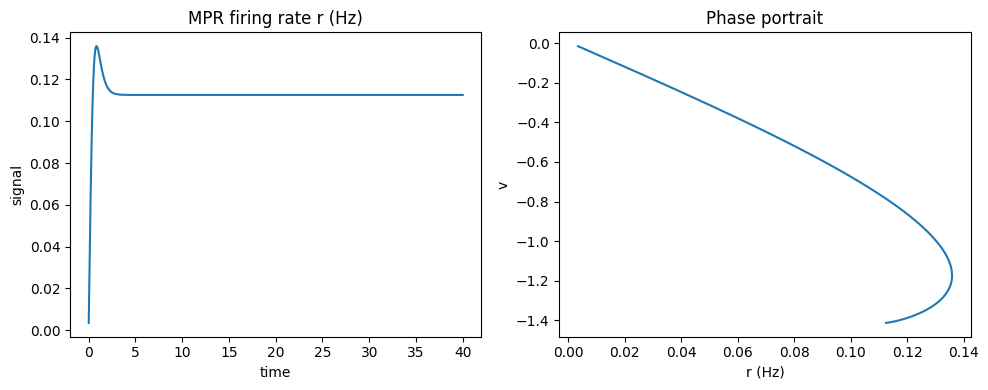
With a transient depolarizing drive v_inp the population emits a burst that the firing rate r tracks exactly.
sim = brainmass.Simulator(node, dt=0.01 * u.ms)
res = sim.run(40. * u.ms, inputs=lambda i, t: (None, 3.0),
              monitors=['r', 'v'])
res['r'].shape, u.get_unit(res['r'])
((4000, 1), Unit("Hz"))
Visualize#
The firing rate is unit-aware (Hz); viz strips units automatically. The phase portrait shows the \((r, v)\) trajectory.
fig, axes = plt.subplots(1, 2, figsize=(10, 4))
brainmass.viz.plot_timeseries(res['r'], ts=res['ts'], ax=axes[0])
axes[0].set_title('MPR firing rate r (Hz)')
brainmass.viz.plot_phase_portrait(res['r'], res['v'], ax=axes[1])
axes[1].set_xlabel('r (Hz)'); axes[1].set_ylabel('v')
axes[1].set_title('Phase portrait')
plt.tight_layout()
plt.show()
Try it: vary the excitability eta#
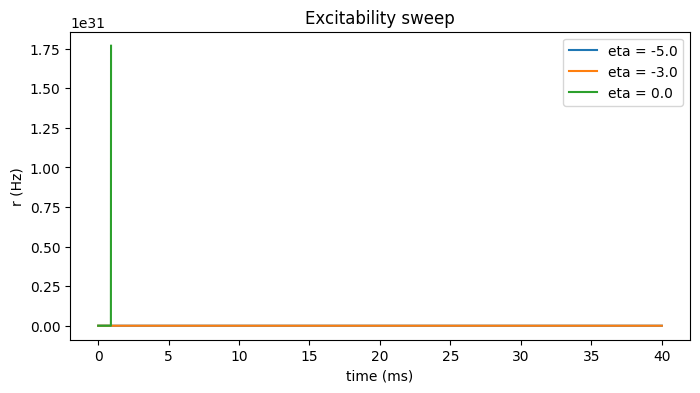
The mean external current eta moves the population between a low-rate resting state and a high-rate active state.
fig, ax = plt.subplots(figsize=(8, 4))
for eta in [-5.0, -3.0, 0.0]:
    m = brainmass.MontbrioPazoRoxinStep(in_size=1, eta=eta, J=15.0)
    r = brainmass.Simulator(m, dt=0.01 * u.ms).run(
        40. * u.ms, inputs=lambda i, t: (None, 3.0), monitors=['r'])
    ax.plot(u.get_magnitude(r['ts']), u.get_magnitude(r['r'])[:, 0], label=f'eta = {eta}')
ax.set_xlabel('time (ms)'); ax.set_ylabel('r (Hz)'); ax.legend()
ax.set_title('Excitability sweep')
plt.show()